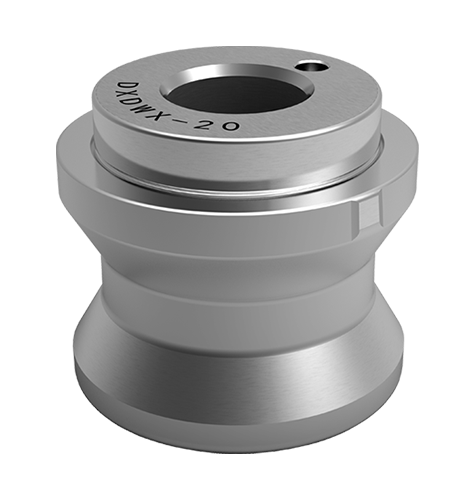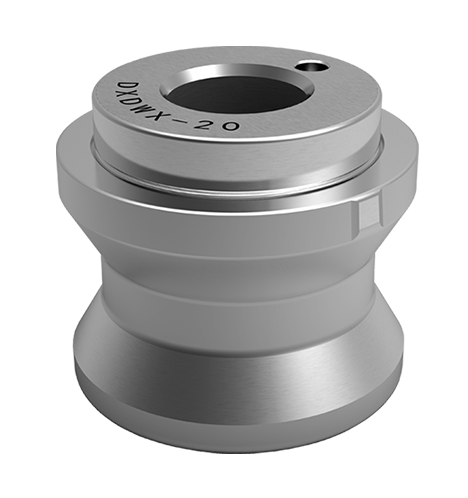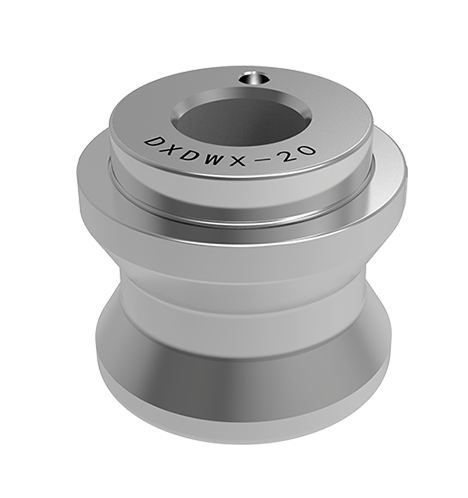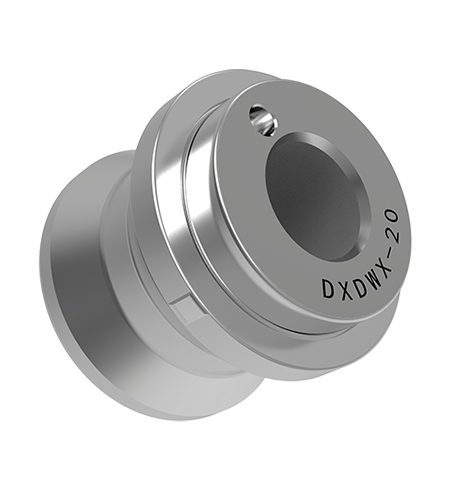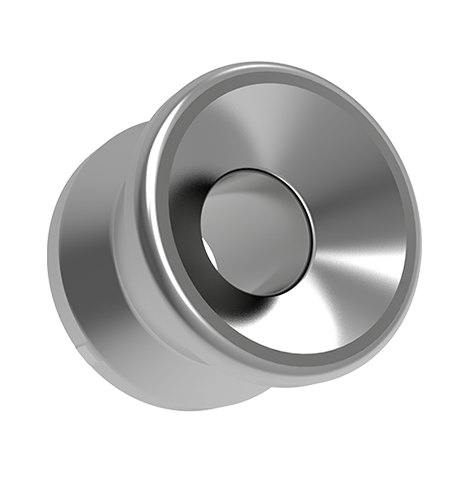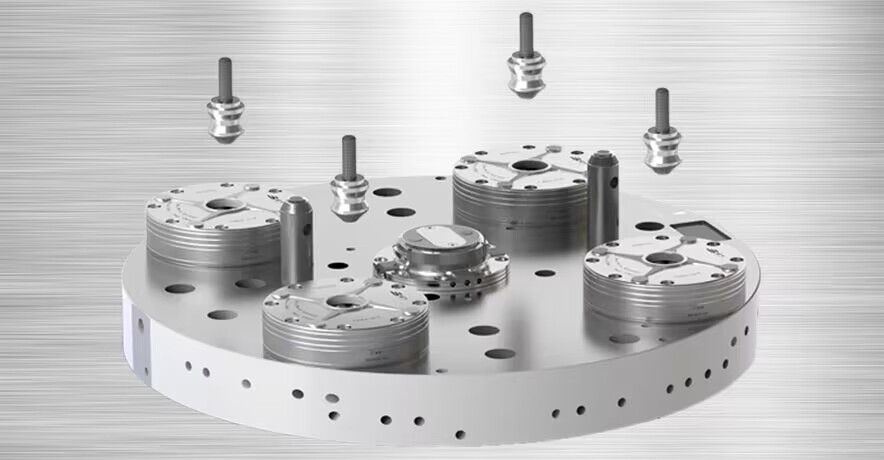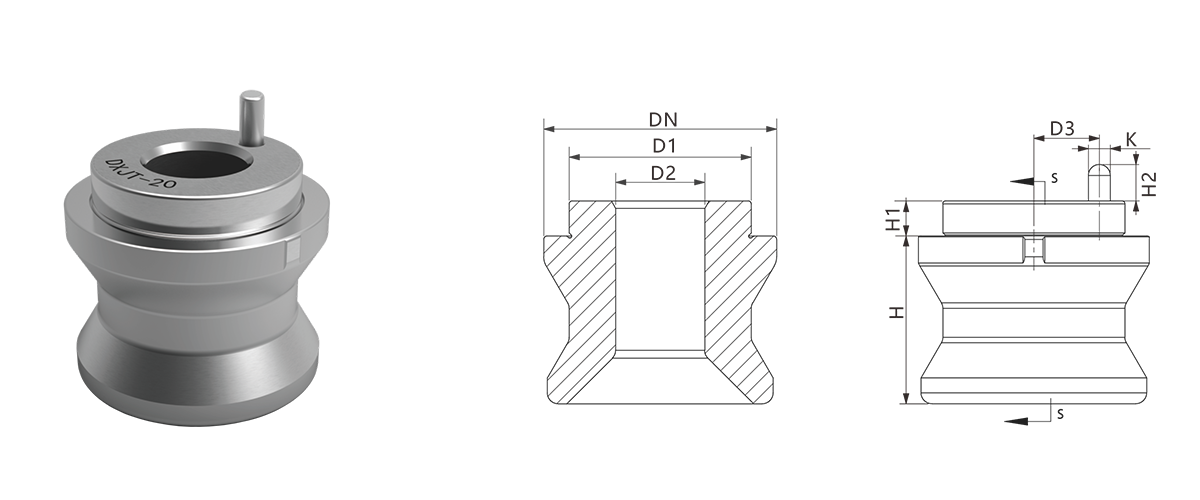
Positioning pin, hardening treatment.
High 28mm (without directional key), weight 105g.
It only limits the degree of freedom of rotation and plays a directional role.
The Angle between the guide hole and the positioning side is 45°, which is suitable for the straight column ball lock zero positioner.
Hardening treatment;
The Angle between the guide hole and the positioning edge is 45°;
Only limit the freedom of rotation, play a directional role;
Suitable for straight column ball lock zero positioner.

| Order number | ØDN |
ØDN1 (h6) |
ØD2 | D3 | H | H1 | H2 | K | Weight(g) |
|---|---|---|---|---|---|---|---|---|---|
| DXJT-2 | 13 | 10 | 6.2 | 4.5 | 8.9 | 2.1 | 2.5 | 2.2 | 8 |
| DXJT-5 | 18 | 14 | 8.2 | 5.5 | 12.8 | 2.7 | 3 | 2.2 | 16 |
| DXJT-10 | 22 | 15 | 8.3 | 5.75 | 16.3 | 3 | 3 | 2 | 30 |
| DXJT-20 | 32 | 25 | 12.2 | 9 | 23 | 5 | 4 | 3 | 105 |
| DXJT-40 | 40 | 30 | 16.3 | 11.5 | 29 | 5 | 4 | 3 | 188 |
A short-cone ball lock zero-point positioning system uses a short-cone locating interface combined with a ball-lock clamping mechanism to position and secure compatible fixtures or pallets. The system is designed for repeatable CNC workholding and quick fixture changeover.
The short-cone locating interface establishes the positioning reference between the zero-point receiver and the compatible fixture or pallet. The ball-lock mechanism secures the interface, while the pneumatic system can be used to release the clamping mechanism during fixture changeover.
Yes. The compact locating interface and repeatable positioning concept make the system suitable for selected 5-axis machining and multi-axis workholding applications. The final configuration should be selected according to the machine, fixture geometry and machining requirements.
This configuration uses pneumatic actuation for releasing the clamping mechanism. The exact operating pressure, clamping force and installation requirements depend on the selected model and technical specification.
The applicable SET configuration can provide repeatability up to 0.005 mm. Actual performance depends on the product model, installation accuracy, locating interface, fixture condition and machining environment. Please refer to the specific product drawing for the exact specification.
Yes. The zero-point interface can be integrated with compatible custom fixtures, pallets and workholding plates. Fixture dimensions, locating interface, pull studs and clamping requirements should be confirmed before production.
Yes. The pneumatic configuration can be integrated into automated fixture and pallet changeover systems. Additional sensors, air connections, robotic interfaces or control components may be required depending on the automation design.
Selection depends on the required positioning accuracy, clamping force, fixture size, workpiece weight, machine-table configuration, installation method and automation requirements. SET can recommend a suitable configuration after reviewing the machine and fixture information.
Yes. SET is a manufacturer specializing in zero-point positioning systems, zero-point clamping systems, gripping systems, clamping systems and customized tooling solutions for CNC machining and industrial automation.
Yes. SET provides customized zero-point positioning and workholding solutions according to machine-table dimensions, fixture requirements, workpiece size, positioning accuracy, clamping force and automation conditions.
Yes. Technical drawings, product specifications and configuration information can be provided for applicable products. Customers can contact SET with their machine model, fixture dimensions and application requirements to confirm the correct configuration.
SET can support customized industrial workholding and tooling projects. OEM or non-standard requirements should be evaluated according to the technical specifications, application conditions and production requirements of the project.
For a zero-point positioning system quotation, provide the CNC machine type, machine-table dimensions, fixture or pallet dimensions, workpiece weight, required positioning repeatability, clamping requirements, pneumatic conditions and automation requirements. Drawings or photos are also helpful for technical evaluation.
If you are interested in our products, please consult us