

 English
 русский
 Español
 简体中文
简体中文
A robot cell that runs five different part numbers in one shift is no longer unusual. The air gripper at the end of the arm picks and places, but when the product changes, the gripper often has to be...
Read More
Micron-Level Precision Lockup | SET Zero-Point Clamping Systems Power a Revolution in Turn-Mill Flexible Machining
Overview
As high-end turn-mill composite machining becomes increasingly critical for aerospace, military, automotive, and precision mold manufacturing, traditional fixture clamping and manual setup processes have gradually become the core bottleneck restricting factory efficiency, consistency, and automated production. To resolve long-standing pain points including time-consuming fixture replacement, manual alignment errors, unstable clamping rigidity, and low machine utilization, SET launches a professional zero-point clamping solution to revolutionize conventional turn-mill production workflows, enabling micron-level repetitive positioning and second-level fixture changeover for modern flexible manufacturing.
Persistent Machining Bottlenecks Limit High-End Manufacturing Profitability
Turn-mill composite machine tools are core equipment for high-precision and complex part processing, widely adopted in high-standard precision manufacturing scenarios. However, traditional clamping methods rely heavily on manual positioning, bolt fastening, and repeated dial alignment. Each production changeover typically requires 20 to 30 minutes of manual setup and calibration, resulting in extremely long machine downtime.
In addition, manual clamping commonly causes positioning deviation and machining chatter, leading to unstable dimensional accuracy, inconsistent batch quality, and high scrap rates. Although many enterprises are equipped with high-performance turn-mill machines, low equipment utilization and manual-dependent production severely restrict capacity expansion and profit improvement, forming a typical “high-end equipment, low-efficiency production” dilemma.
SET Zero-Point System Breaks Turn-Mill Machining Limitations
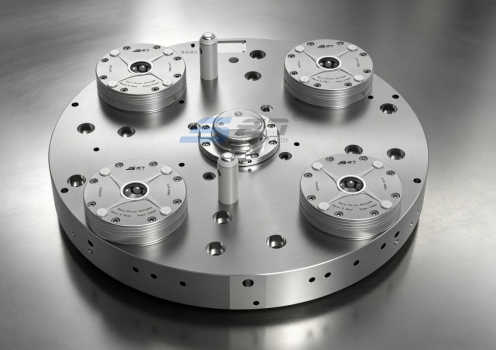
The SET zero-point clamping system completely subverts traditional fixture logic. Rather than a single accessory component, it serves as a full-process flexible machining solution covering pneumatic and hydraulic zero-point modules, standard fixture pallets, precision retention studs, and supporting positioning accessories. Fully compatible with vertical, horizontal, and composite turn-mill centers, the system realizes unified datum positioning, rapid fixture replacement, and stable rigid clamping throughout the entire production process.
By building a standardized zero-point datum on the machine table and offline pre-adjustment platform, the system separates “machine processing” and “workpiece setup”, fundamentally eliminating downtime caused by frequent fixture disassembly and manual calibration.
Micron-Level Accuracy & Second-Level Changeover Rebuild Production Efficiency Standards
Precision stability is the core advantage of the SET zero-point solution. The system controlsrepetitive positioning errors within a micron range, completely eliminating cumulative errors caused by repeated clamping and ensuring ultra-high consistency in batch production. It effectively reduces defective rates and improves overall machining quality stability.
In terms of production efficiency, the solution realizes tool-free quick change and zero alignment. Traditional half-hour setup time is compressed to seconds-level clamping and minutes-level changeover. The overall equipment effectiveness (OEE) of turn-mill machines is successfully increased from less than 40% to more than 70%. With the “load-and-process” working mode, enterprises greatly reduce non-cutting idle time and achieve continuous and efficient production.
High Rigidity Clamping Realizes Dual Value of Quality Improvement and Cost Reduction
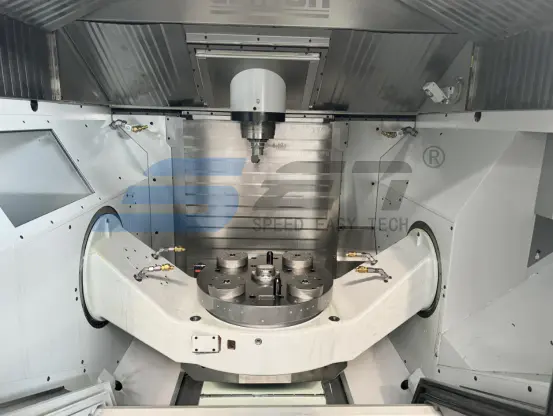
Aiming at complex turn-mill machining conditions such as high-speed rotation, composite cutting, and finish machining, the SET zero-point clamping structure features excellent overall rigidity and vibration resistance. It effectively suppresses machining chatter during multi-angle and multi-process composite cutting, ensuring stable surface quality and accurate dimensional tolerance for high-precision parts.
Moreover, the standardized quick-change operation greatly reduces reliance on senior technicians. New operators can complete fixture replacement and clamping independently after simple training. One worker can manage multiple turn-mill devices simultaneously, significantly lowering labor costs while avoiding quality fluctuations caused by human operation errors, realizing dual optimization of “quality improvement and cost reduction”.
Strong Flexibility Fully Empowers Diversified High-End Manufacturing
Fully adapted to Industry 4.0 and flexible factory construction, the SET zero-point system supports seamless docking with automated loading and unloading units, robotic systems, and FMS production lines. It can freely switch between small-batch customized production and large-batch standardized manufacturing.
Whether for ultra-precision aerospace components, high-standard military parts, complex automotive structural components, or high-precision mold workpieces, the system delivers stable and unified positioning datum and flexible changeover capability. It breaks the single-process limitation of traditional turn-mill equipment and upgrades the comprehensive production capacity of intelligent workshops.
Conclusion: Zero-Point Technology Leads a New Era of Flexible Turn-Mill Machining
The popularization and application of the SET zero-point clamping system marks a crucial technological upgrade in the field of turn-mill composite machining. It solves traditional pain points such as slow changeover, low precision consistency, low automation compatibility, and high labor dependence.
With micron-level precision locking, second-level flexible changeover, high-rigidity stable clamping, and universal automated compatibility, SET helps manufacturing enterprises break capacity bottlenecks, stabilize batch quality, reduce comprehensive production costs, and continuously strengthen core competitiveness in high-end precision machining.
SET Zero-Point System — Empowering efficient, precise, and flexible turn-mill manufacturing.
latest news

- Air Gripper Selection Guide: Types, Grip Force, and Automation Integration
- CNC Pallet System Guide: How Zero-Point Pallet Quick Change Cuts Setup Time
- Pneumatic Workholding Solutions: How to Cut Your CNC Setup Time and Errors
- Machine Tending Tools: How Quick-Change Grippers and Zero-Point Systems Cut CNC Downtime
Latest news
-
CNC Pallet System Guide: How Zero-Point Pallet Quick Change Cuts Setup TimeImagine a vertical machining center with the spindle stopped while the operator swaps a vise, indicates a fixture, and touches off three new tools. Fifteen minutes per changeover seems small until it...Read More
-
Pneumatic Workholding Solutions: How to Cut Your CNC Setup Time and ErrorsWorkholding is often the hidden time thief in a machining shop. A part that takes three minutes to clamp can turn a 30-second cycle into a 3-minute event, and across a shift that drains every hour of...Read More
-
Machine Tending Tools: How Quick-Change Grippers and Zero-Point Systems Cut CNC DowntimeA production manager watches the clock. The spindle stops, the operator walks over, waits for the table to unclamp, swaps a fixture, re-clamps, and starts the next part. That scene repeats several ti...Read More
-
Machine Tending Fixtures: Key Factors Behind a Stable CNC Machining CellThe night shift operator calls maintenance before the robot has run for an hour. The arm comes down to the same teach point every cycle, but the part is 0.03 mm off in the fixture. Within minutes the...Read More
-
5-Axis Workholding: How Zero-Point Systems and Vises Maximize Machining StabilityA five-axis machining center is only as good as the workholding that supports it. A fixture that blocks the rotary table or interferes with the cutter path turns a five-axis machine into a three-axis...Read More
Contact Details
- Address: 1-4 Floors, 17#03, Building 17, No. 269, Xinfeng Road, Xukou Town, Wuzhong District, Suzhou City
- Fax: +86-18112607008
- Tel: 18112607008
- Email: [email protected]
Mobile terminal
Copyright © SET Industrial | Zero-Point Positioning & CNC Workholding ALL RIGHTS RESERVED.