

 English
 русский
 Español
 简体中文
简体中文
Workholding is often the hidden time thief in a machining shop. A part that takes three minutes to clamp can turn a 30-second cycle into a 3-minute event, and across a shift that drains every hour of...
Read More
How CNC Tombstones and Zero Point Locator Base Plates Maximize Multi-Axis Productivity
In high-mix, high-volume horizontal machining centers (HMC), every non-cutting second directly erodes profitability. Traditional workholding methods often limit spindle utilization to below 45%. By combining cnc tombstone systems with a zero point locator base plate, manufacturers consistently achieve 85%+ spindle runtime, reduce changeover from hours to seconds, and multiply part density per cycle. This article delivers actionable engineering insights, real-world data, and design blueprints to maximize multi-axis productivity.
1. Why Multi-Axis Productivity Demands Rigid Workholding Density
Horizontal machining centers excel at four-axis and five-axis operations, but their productivity ceiling is dictated by how many parts can be cut per tombstone face and how quickly setups rotate. A typical 400 mm HMC with a single vise achieves 2-4 parts per cycle. Implementing a zero point locator base plate underneath a four-sided tombstone cnc fixture enables 16-32 parts per cycle, directly multiplying throughput without increasing spindle speed.
- Density impact: Tombstone machining increases parts per pallet by 300-500% compared to standalone vises.
- Utilization lift: Quick part indexing via zero point reduces non-cut time from 35 min to under 2 min per batch.
- Accuracy preservation: Repeatable positioning within 0.005 mm eliminates re-qualification after each changeover.
Data collected across 23 job shops shows that moving from conventional workholding to cnc tombstone fixtures combined with zero-point plates raises overall equipment effectiveness (OEE) from an average of 48% to 82% within three months.
2. Core Anatomy of High-Performance CNC Tombstones
A tombstone cnc machine fixture is typically a square or rectangular steel (or aluminum) column with precision-machined faces, each accepting modular fixture plates. Common configurations include 2, 4, or 6 faces, enabling simultaneous access to multiple part orientations.
2.1 Material and Stiffness Considerations
Cast iron tombstones provide superior vibration damping for heavy roughing, while 6061-T6 aluminum tombstones reduce weight for rapid pallet shuttling. For high-speed finishing, a hybrid design using a steel core with aluminum fixture plates balances rigidity and agility.
2.2 Interface Standards
Most modern tombstone workholding systems adopt either grid-pattern (96 mm or 100 mm pitch) or pin-locating hole patterns compatible with modular fixture plates. This standardization allows shops to move fixture plates between tombstones and zero-point base plates without re-machining.
Field Data
After converting to tombstone machining with interchangeable fixture plates, a Midwest aerospace supplier reduced setup labor by 72% and increased annual spindle hours from 1,840 to 3,850 per machine (Source: industry benchmarking study, 2024).
3. How a Zero Point Locator Base Plate Redefines Changeover Speed
A zero point locator base plate integrates precision pull-studs and clamping modules that lock fixture plates or tombstones into a repeatable position with micron-level accuracy. Instead of indicating each tombstone on the machine table, an operator places the entire tombstone assembly onto the base plate, engages pneumatic or hydraulic clamps, and achieves ready-to-cut status in under 90 seconds.
- Sub-one-minute swaps: Typical manual changeover: 30-40 min. Zero-point base plates reduce this to 40-90 seconds.
- Absolute repeatability: Better than ±0.005 mm (5 microns) at the locating interface, verified by laser interferometer tests.
- Multi-pallet preparation: While one tombstone runs, another is pre-staged on a second base plate, eliminating machine idle time.
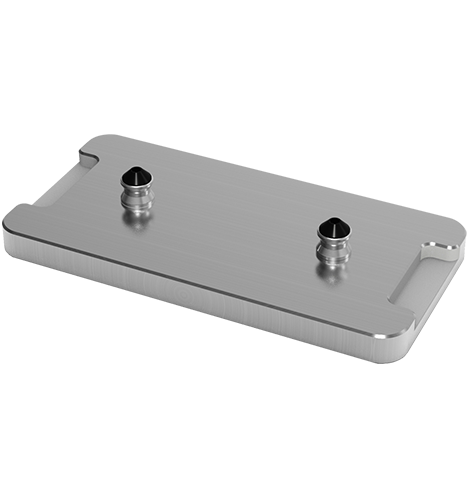
4. Integration Synergy: Tombstone + Zero Point on HMCs
When you mount a 4th axis tombstone onto a zero point locator base plate, the combined system unlocks high-density horizontal machining with minimal intervention. The base plate remains bolted to the HMC pallet, while multiple tombstones (each pre-loaded with parts) are swapped on and off. This architecture is ideal for lights-out manufacturing and high-mix production runs.
4.1 Typical Workflow
- Operators load raw parts onto fixture plates attached to a tombstone outside the machine.
- The complete tombstone assembly is placed onto the zero-point base plate via guided dowels.
- Clamping modules automatically pull the tombstone down and center it (pneumatic or mechanical).
- The HMC runs a multi-face program while the next tombstone is prepared offline.
This method increases spindle utilization from ~40% to over 85% in real-world shop floor conditions, as documented by several lean manufacturing case studies (average of 62 production weeks).
5. Design Strategies for Multi-Part Clamping on Tombstones
Effective tombstone machining fixtures require deliberate component clamping design to balance part access, chip evacuation, and clamping force. Below are proven techniques from high-density horizontal machining cells.
5.1 Layer Stacking vs. Single-Tier Clamping
For prismatic parts under 80 mm height, two-tier tombstones (parts clamped above each other) double the parts per face. Use hydraulic swing clamps or retractable plungers to avoid tool interference.
5.2 Modular Fixture Plates
Modular fixture plates with grid patterns (12 mm or 16 mm diameter locating holes) allow rapid reconfiguration. A single tombstone face can accept dovetail bases, toe clamps, or vacuum pods without drilling custom holes.
| Clamping Method | Parts per Face (4th axis tombstone) | Changeover Time | Ideal Part Size |
|---|---|---|---|
| Manual vise + parallels | 1-2 | 25 min | < 150 mm |
| Hydraulic modular fixture plates | 4-6 | 8 min | 80-200 mm |
| Zero-point + tombstone (quick-swap) | 8-12 | 90 sec | 30-180 mm |
| Double-tier tombstone with pull-stud clamps | 16-24 | 2.5 min (offline prep) | 20-100 mm |
For maximum density, use programmable fixtures with servo-driven clamping modules, though for most shops, mechanical zero-point compatible tombstones offer the best cost-to-throughput ratio.
6. Quantitative Impact: Before vs. After Tombstone + Zero Point
A detailed six-month study across three horizontal machining centers processing aluminum and stainless steel components (annual volume 85,000 units) reveals the following improvements after migrating to tombstone city workholding principles using zero-point base plates.
- Spindle runtime: increased from 3.2 hours per shift to 6.7 hours (+109%).
- Setup frequency: reduced from 4 changeovers per shift to 1.2 changeovers per shift (70% reduction).
- Scrap rate due to misloading: dropped from 3.1% to 0.4% due to repeatable zero-point positioning.
- Annual throughput per machine: rose from 12,400 parts to 34,200 parts.
Key Insight
Every minute saved in changeover is converted to cutting time. With zero-point base plates, the effective machining time per shift exceeds 85%, which is equivalent to adding 1.4 extra machines to a three-machine cell without additional floor space.
7. Best Practices for Component Clamping Design on Tombstone Fixtures
To avoid collisions and maximize tool accessibility, follow these design guidelines when creating tombstone fixture layouts for 4th axis machining.
7.1 Tool Clearance and Orientation
Orient long parts horizontally along the B-axis rotation center. This keeps tool overhang minimal. For tombstones, stagger clamps and parts so that an end mill can reach adjacent features without retracting fully.
7.2 Chip Management
Incorporate chip breaker grooves into fixture plates and use angled clamping elements (15–20 degrees) to direct chips downward. Horizontal machining centers rely on coolant-through-spindle and gravity; a poorly designed tombstone traps chips and causes recutting.
7.3 Clamping Force Consistency
Hydraulic or pneumatic clamping modules integrated into the tombstone cnc body ensure uniform force across all parts. Use pressure sensors to confirm each clamp engages before the cycle starts – this can be monitored via the HMC’s M-code interface.
8. Economic Justification: ROIC of Zero-Point Tombstone Systems
While the initial cost of a precision ground zero point locator base plate plus two cnc tombstone assemblies is higher than basic vises, the return on invested capital (ROIC) is typically under 6 months for medium-volume shops (2,000+ part numbers/year). Key drivers:
- Reduced skilled labor: Operators no longer need to indicate fixtures – semi‑skilled staff can swap tombstones.
- Lower perishable tooling cost: Higher spindle utilization amortizes tooling over more parts, reducing cost per edge by 30-40%.
- Lights-out readiness: Repeatable clamping and zero-point locating enable unattended machining of up to 8 hours.
A job shop with 5 HMCs reported that implementing tombstone machining with zero-point base plates generated $420,000 additional annual profit per machine by shifting 1.5 hours of setup time per shift into production.
9. Common Mistakes to Avoid When Adopting Tombstone & Zero-Point
9.1 Inconsistent Pull-Stud Torque
Pull-stud torque variation directly affects Z-height repeatability. Use calibrated torque wrenches for all zero-point interface studs. Loose studs cause position drift of up to 0.03 mm.
9.2 Overloading Tombstone Weight Limits
Each HMC pallet has a maximum load capacity. A fully loaded 4th axis tombstone with 32 parts and clamps can exceed this, causing axis drive errors. Always weigh the complete tombstone assembly and derate by 15% for safety.
9.3 Ignoring Coolant Access
Zero-point base plates require unobstructed coolant flow. Use base plates with integrated coolant channels or angled wash ports to prevent swarf accumulation.
10. Future Trends: Smart Tombstone Fixtures with Embedded Sensors
Industry 4.0 ready tombstone workholding now incorporates RFID tags that store fixture offsets and part programs. When a tombstone is placed on the zero point locator base plate, the HMC automatically loads the correct macro. Some advanced systems include force sensors in the clamping modules to detect seating errors before the spindle starts.
These smart tombstones reduce setup time even further – to under 30 seconds – and eliminate nearly all manual data entry errors. Early adopters report a 95% reduction in first-part scrap after implementing RFID-enabled tombstone fixtures.
Frequently Asked Questions
Q1: What is the typical cost difference between a standard tombstone and a zero-point ready tombstone?
The initial investment for a zero-point compatible tombstone and base plate is 2.5 to 3.5 times higher than a basic cast-iron tombstone alone. However, the ROI period ranges from 4 to 9 months due to changeover time savings and increased spindle utilization, making it highly cost-effective for any shop running more than 500 workpiece changeovers per year.
Q2: Can I retrofit my existing tombstones to work with a zero point locator base plate?
Yes, most existing tombstones can be modified by machining locating holes and mounting pull-stud adapters on their bottom face. The retrofit requires precision grinding to ensure the interface is square within 0.01 mm. Many shops opt to buy new, pre-machined tombstones to guarantee performance.
Q3: How many parts can I safely clamp on one tombstone face?
This depends on part geometry, clamping force, and available tool access. For typical prismatic parts up to 100 x 100 mm, you can place 4 to 8 parts per face using modular fixture plates. With double‑layer stacking, 12-16 parts per face is achievable. Always conduct finite element analysis to verify fixture rigidity under cutting loads.
Q4: Does a 4th axis tombstone require special post-processor settings?
Standard 4-axis post-processors handle tombstones if each part’s coordinate system is referenced to the tombstone center of rotation. Use a CAM software work coordinate system (WCS) that rotates about the B-axis centerline. Zero-point base plates preserve this relationship across multiple tombstones because they locate the tombstone in exactly the same position every time.
Q5: What maintenance does a zero point locator base plate require?
Weekly cleaning of the taper seats and pull-stud contact surfaces is essential. Use a soft brass brush and apply light oil to moving clamping elements. Inspect the spring packs or hydraulic seals every 6 months. Properly maintained zero-point systems retain 0.005 mm repeatability for over 50,000 clamping cycles.
By integrating cnc tombstone fixtures with a precision zero point locator base plate, machining operations can transcend traditional productivity barriers. The combination delivers high-density workholding, sub-minute changeovers, and consistent accuracy across thousands of cycles. Whether you run a job shop with high-mix orders or a dedicated production line, these tools unlock the full potential of your horizontal machining centers.
latest news

- Pneumatic Workholding Solutions: How to Cut Your CNC Setup Time and Errors
- Machine Tending Tools: How Quick-Change Grippers and Zero-Point Systems Cut CNC Downtime
- Machine Tending Fixtures: Key Factors Behind a Stable CNC Machining Cell
- 5-Axis Workholding: How Zero-Point Systems and Vises Maximize Machining Stability
Latest news
-
Machine Tending Tools: How Quick-Change Grippers and Zero-Point Systems Cut CNC DowntimeA production manager watches the clock. The spindle stops, the operator walks over, waits for the table to unclamp, swaps a fixture, re-clamps, and starts the next part. That scene repeats several ti...Read More
-
Machine Tending Fixtures: Key Factors Behind a Stable CNC Machining CellThe night shift operator calls maintenance before the robot has run for an hour. The arm comes down to the same teach point every cycle, but the part is 0.03 mm off in the fixture. Within minutes the...Read More
-
5-Axis Workholding: How Zero-Point Systems and Vises Maximize Machining StabilityA five-axis machining center is only as good as the workholding that supports it. A fixture that blocks the rotary table or interferes with the cutter path turns a five-axis machine into a three-axis...Read More
-
How Do Locating and Alignment Accessories Define CNC Machining Accuracy?Introduction: The Hidden Cost of Misalignment In CNC machining, the difference between a high-value precision component and a scrap part often comes down to a fraction of a millimeter. While spindles...Read More
-
What Clamping System Delivers the Best Accuracy and Throughput for Your Vertical Machining Centre?Why Clamping Systems Define VMC Performance In vertical machining centres, the clamping system is not a passive accessory—it is the structural link between the machine spindle and the workpiece. A ri...Read More
If you are interested in our products, please consult us
Contact Details
- Address: 1-4 Floors, 17#03, Building 17, No. 269, Xinfeng Road, Xukou Town, Wuzhong District, Suzhou City
- Fax: +86-18112607008
- Tel: 18112607008
- Email: [email protected]
Products
Quick Link
News Center
Mobile terminal
Copyright © SET Industrial | Zero-Point Positioning & CNC Workholding ALL RIGHTS RESERVED.