

 English
 русский
 Español
 简体中文
简体中文
The night shift operator calls maintenance before the robot has run for an hour. The arm comes down to the same teach point every cycle, but the part is 0.03 mm off in the fixture. Within minutes the...
Read More
How Manual Locating Devices Compare to Pneumatic Zero Point Positioning Systems in CNC Workholding
Why Workholding Method Selection Drives Shop Floor Economics
Every machining cell lives or dies on the seconds spent between parts, not the seconds spent cutting metal. A shop running three-axis mills eight hours a day can lose more time to fixture changeover than to actual chip removal if the clamping method is poorly matched to the job mix. This is why the decision between a manual locating device and a pneumatic zero point positioning system deserves the same scrutiny as spindle speed or tool selection.
The two approaches solve the same underlying problem, repeatable part location on a fixture plate, but they arrive at very different cost structures, cycle times, and operator workloads. Understanding where each one fits is the difference between a workholding upgrade that pays for itself in months and one that sits underused in a drawer.
Field observation: Shops switching from bolt-down fixturing to a structured zero point approach commonly report changeover reductions in the range of 70 to 90 percent per fixture swap, though the exact figure depends heavily on part complexity and batch size.
Manual Locating Device: Mechanics, Strengths, and Limits
A manual locating device is a mechanical positioning element, typically a locating ring, pin, or collar, that an operator engages by hand to seat a workpiece or fixture plate in a known reference position. The device itself does not generate clamping force; it establishes location, and a separate clamp, bolt, or lever secures the part.
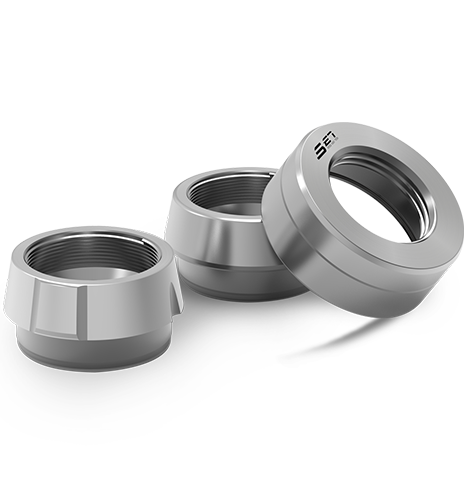
Where Manual Systems Excel
- Low upfront capital cost compared with automated positioning hardware
- No dependency on shop air supply, electrical control, or software integration
- Simple mechanical design means fewer failure points and easier field repair
- Well suited to low-mix, long-run production where fixtures rarely change
Where Manual Systems Fall Short
- Changeover time scales directly with operator skill and fatigue level
- Repeatability depends on consistent manual technique, introducing variance shift to shift
- Not practical for lights-out or unattended machining cycles
- Scaling to multiple pallets or high-mix jobs multiplies labor overhead
In practice, a manual locating device remains a sound choice for job shops running a narrow part family with infrequent fixture swaps, where the labor cost of manual seating is small relative to total run time.
Pneumatic Zero Point Positioning System: Automated Repeatability at the Fixture Interface
A pneumatic zero point positioning system replaces manual seating and clamping with air-actuated locking modules mounted below the fixture plate or pallet. Compressed air drives a locking mechanism, often a ball-lock or collet-style element, into engagement, pulling the plate down onto a reference surface with consistent, repeatable force every cycle.
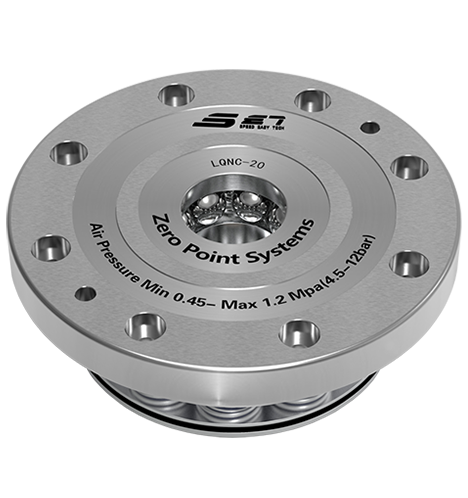
Core Operating Principle
The system typically works through three stages: air pressure retracts or extends a locking element inside the base module, the fixture plate's mating stud engages the module, and locked-in spring or air force holds the plate to sub-ten-micron repeatability across thousands of cycles. Because the locking force comes from a controlled pneumatic circuit rather than a human hand, part-to-part variance in clamping force drops sharply.
Operational Advantages
| Factor | Typical Impact |
|---|---|
| Changeover time | Seconds instead of minutes per fixture swap |
| Repeatability | Consistent location within single-digit micron range |
| Operator dependency | Minimal, engagement is push-button or automatic |
| Compatibility with automation | Integrates with robot loading and pallet changers |
The tradeoff is straightforward: higher initial investment in modules, air supply infrastructure, and often control valves or sensors to confirm lock state before a cycle starts.
Manual Versus Pneumatic: A Structured Comparison
Choosing between the two is rarely about which technology is objectively better. It is about matching the system to production volume, part variety, and available capital. The table below lays out the tradeoffs across the factors that matter most on the shop floor.
| Criteria | Manual Locating Device | Pneumatic Zero Point Positioning System |
|---|---|---|
| Initial cost | Low | Moderate to high |
| Changeover speed | Minutes, operator dependent | Seconds, largely automatic |
| Repeatability | Variable with technique | Consistently high |
| Infrastructure needed | None beyond the fixture itself | Compressed air, possibly control logic |
| Best fit | Low-mix, long-run jobs | High-mix, frequent changeover, automated cells |
| Maintenance | Minimal, mostly wear inspection | Periodic seal and air line checks |
A useful rule of thumb: if fixture changeovers happen more than a handful of times per shift, the labor savings from a pneumatic system typically outweigh the added equipment cost within one to two years, depending on machine hourly rate and batch size.
Visualizing the Changeover Workflow
The diagram below contrasts the sequence of steps for each approach, from part arrival at the machine to cycle start.
Gripping Systems: The Missing Link in Complete Workholding
Locating and clamping the fixture plate is only half the workholding equation. The other half is how the individual part is held once the plate is seated. This is where gripping systems come into play, mechanisms that clamp, center, or grip the raw part or subassembly directly, often in combination with either manual or pneumatic zero point bases.
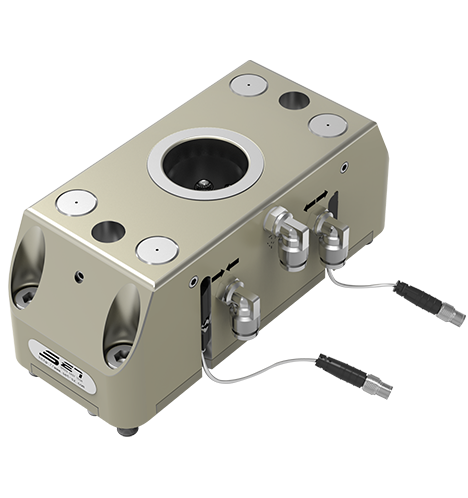
Common Gripping System Types
- Centric vises that self-center a part along a single axis
- Pneumatic or hydraulic power chucks for cylindrical parts
- Modular jaw systems that swap quickly between part families
- Multi-station grippers for pallet-based automated cells
When gripping systems are paired with a pneumatic zero point positioning system, the entire changeover, from empty table to part-ready-for-cutting, can be compressed into a single automated or semi-automated motion. This pairing is particularly valuable in flexible manufacturing systems where the machine may see a different part every cycle.
Machine Operator Productivity and Production Throughput
Changeover time is a direct multiplier on spindle utilization. Consider a machine running fifty short-cycle parts per shift. If each fixture swap costs five minutes under a manual regime, that is over four hours of non-cutting time across a shift. Compress that same swap to fifteen seconds with a pneumatic system and the reclaimed spindle time can approach three and a half hours, time that converts directly into additional parts produced or reduced overtime.
Where the Gains Concentrate
| Production Pattern | Expected Benefit from Automation |
|---|---|
| High-mix, low-volume job shop | Large, changeover count is high relative to run length |
| Low-mix, high-volume dedicated line | Smaller, fixtures rarely change |
| Mixed-batch with frequent engineering changes | Large, flexibility reduces re-tooling downtime |
Operator fatigue is a secondary but real factor. Manual seating and torque-checking bolts repeatedly across an eight or twelve hour shift introduces both physical strain and a rising error rate toward the end of a shift. Automated locking removes that variable entirely, which also supports more consistent quality metrics across shifts.
CNC Workholding Best Practices for Flexible Manufacturing Systems
Flexible manufacturing systems, where multiple machines share pallets, robots, or conveyors, place additional demands on workholding beyond a single standalone machine. A few practices consistently separate well-run flexible cells from ones that struggle:
- Standardize the zero point interface across every machine in the cell so pallets are interchangeable without adjustment
- Build in lock-state confirmation, whether through air pressure sensors or proximity switches, before allowing a cycle to start
- Keep spare locking modules on hand, since a single failed module can halt an entire automated line
- Match gripping system jaw sets to part families in advance so robot changeover sequences do not require manual intervention
- Schedule preventive maintenance on air lines and seals rather than waiting for failure, since pneumatic downtime is harder to diagnose mid-shift than a manual mechanical issue
A cell is only as flexible as its slowest fixture change. Standardizing the zero point interface across machines is consistently the single highest-leverage decision in flexible manufacturing system design.
How to Decide Which System Fits Your Shop
The right answer depends on a small set of practical questions rather than a general preference for automation. Consider the following before committing capital:
- How many times per shift does a fixture actually change?
- What is the fully loaded hourly cost of the machine sitting idle during changeover?
- Is compressed air already available and reliable at the machine, or would it need new infrastructure?
- Does the part mix justify investment in matching gripping systems as well, or is a simple manual solution sufficient for the foreseeable production plan?
- Is unattended or lights-out operation part of the roadmap, in which case manual seating is not a realistic option regardless of cost?
Many shops land on a hybrid approach: a pneumatic zero point positioning system on high-mix machines where changeover frequency justifies the investment, and manual locating devices retained on dedicated lines where fixtures rarely move.
Frequently Asked Questions
Q1: Can a manual locating device be upgraded to a pneumatic system later without replacing the fixture plates?
In many cases yes, provided the base plate pattern and stud spacing are compatible with the pneumatic modules being considered. It is worth confirming interface dimensions before purchasing fixtures if a future upgrade is anticipated.
Q2: How much compressed air does a pneumatic zero point positioning system typically require?
Air consumption is generally modest compared with other pneumatic shop equipment, since the modules only actuate briefly during locking and unlocking rather than running continuously.
Q3: Do gripping systems only work with pneumatic bases?
No. Gripping systems can be mounted on fixtures that sit on either manual or pneumatic zero point bases. The choice of gripping mechanism depends more on the part geometry than on the underlying locating method.
Q4: What is the typical repeatability difference between manual and pneumatic systems?
Pneumatic systems generally hold tighter and more consistent repeatability because locking force and seating are controlled mechanically rather than by hand, though a skilled operator using a well-maintained manual locating device can still achieve solid results for less demanding tolerances.
Q5: Is a pneumatic zero point positioning system worth it for a low-volume job shop?
It depends on how often fixtures change. If changeovers are infrequent, the payback period may be long. If the shop handles many small batches with frequent swaps, the labor and spindle-time savings often justify the investment within a reasonable timeframe.
latest news

- Machine Tending Fixtures: Key Factors Behind a Stable CNC Machining Cell
- 5-Axis Workholding: How Zero-Point Systems and Vises Maximize Machining Stability
- How Do Locating and Alignment Accessories Define CNC Machining Accuracy?
- What Clamping System Delivers the Best Accuracy and Throughput for Your Vertical Machining Centre?
Latest news
-
5-Axis Workholding: How Zero-Point Systems and Vises Maximize Machining StabilityA five-axis machining center is only as good as the workholding that supports it. A fixture that blocks the rotary table or interferes with the cutter path turns a five-axis machine into a three-axis...Read More
-
How Do Locating and Alignment Accessories Define CNC Machining Accuracy?Introduction: The Hidden Cost of Misalignment In CNC machining, the difference between a high-value precision component and a scrap part often comes down to a fraction of a millimeter. While spindles...Read More
-
What Clamping System Delivers the Best Accuracy and Throughput for Your Vertical Machining Centre?Why Clamping Systems Define VMC Performance In vertical machining centres, the clamping system is not a passive accessory—it is the structural link between the machine spindle and the workpiece. A ri...Read More
-
What Is the Fastest Way to Reduce CNC Setup Time with Pallet, Gripper, or Manual Quick Change Devices?In high‑mix CNC production, setup time is the largest controllable drag on throughput. Pallet Quick Change Systems, Gripper Quick Change Devices, and Manual Quick Change Devices each address specific...Read More
-
How Zero-Point Systems Improve Workpiece Stability in 5-Axis CNC MachiningWhy Workpiece Stability Breaks Down When 5-Axis Jobs Get Complex A 5-axis machining center earns its value by cutting five faces of a part without a single manual re-clamp. That promise collapses the...Read More
If you are interested in our products, please consult us
Contact Details
- Address: 1-4 Floors, 17#03, Building 17, No. 269, Xinfeng Road, Xukou Town, Wuzhong District, Suzhou City
- Fax: +86-18112607008
- Tel: 18112607008
- Email: [email protected]
Products
Quick Link
News Center
Mobile terminal
Copyright © SET Industrial | Zero-Point Positioning & CNC Workholding ALL RIGHTS RESERVED.