

 English
 русский
 Español
 简体中文
The Real Bottleneck on Horizontal Machining Centers
A horizontal machining center (HMC) can run continuously through faces of a part, but the hours lost between jobs are what often hurt the productio...
Read More
Horizontal Machining Centers: Cut Setup Time with Zero-Point Workholding
The Real Bottleneck on Horizontal Machining Centers
A horizontal machining center (HMC) can run continuously through faces of a part, but the hours lost between jobs are what often hurt the production plan. A typical 20-30 minute fixture change on a worktable becomes a major cost when orders shift daily. If the HMC is producing only a few workpieces per batch, setup time can eat up as much of the day as actual cutting.
The conclusion is simple: cutting setup time matters more than adding spindle speed. Modular workholding, especially zero-point systems, reduces fixture changeover to seconds while preserving repeatability. Instead of losing half an hour, operators push a button or rotate a handle and swap the whole pallet.
What Makes a Horizontal Machining Center Different
An HMC holds the spindle horizontally, so the cutting tool approaches the workpiece from the side. This orientation provides better chip removal, since gravity carries chips out of the cut zone, and it allows the pallet to index or rotate to expose more faces without re-clamping the workpiece. That advantage makes HMCs common for box-shaped parts, aerospace components, and high-volume automotive work.
Compared with a vertical machining center, an HMC requires a different workholding strategy. The table moves along the X and Z axes, while tall workpieces can be clamped on a column or tombstone. Cutting forces can be high, and a poorly supported fixture will cause vibration and poor surface finish. A stable base plate, precise locating pins and a reliable locking mechanism are not extras — they are part of the process.
| Comparison | Horizontal MC | Vertical MC |
|---|---|---|
| Spindle orientation | Horizontal | Vertical |
| Chip evacuation | Excellent | Moderate |
| Multi-face machining | Pallet index | Re-clamp |
| Setup bottleneck | Quick pallet change | Fixture stability |
This table shows why setup time on an HMC is the main lever. Settling on a stable workholding foundation creates the condition to use the machine's full productivity.
How Zero-Point Workholding Solves HMC Setup Problems
Zero-point workholding is a system where a fixture or pallet is located and locked onto a receiver using precise positioning pins and a mechanical or pneumatic locking mechanism. The workpiece coordinate stays consistent from one setup to the next. For HMC use, this normally means a base plate with two, four, six or eight units mounted to the worktable or a column. After the first calibration, every pallet goes back to the same position.
For direct mounting on the worktable, a table-mount type zero-point locator offers a straightforward way to add repeatable fixture exchange without occupying extra vertical space. It can be bolted to the table and then lets you switch pallets or subplates quickly. This is especially useful when the HMC is used for mixed production, where each job needs a different fixture.
A zero-point clamping system can reduce setup time by as much as 90% compared with manual fixture centering, according to the experience documented in existing machining applications. The day saved each month can be returned to cutting metal instead of adjusting clamps.
We have seen this in practice on HMC installations. A small change in the workholding method can turn a high-mix machine from a bottleneck into a flexible production cell. The horizontal machining zero machining application case shows how a zero-point base plate is integrated on the worktable and how the pallet is swapped before each cycle.
Choosing the Right Base Plate and Column for an HMC
Base plate size must match the machine worktable and the pallet system you plan to use. Common sizes range from 250/300/400 mm up to 630/800 mm and 800/1000 mm, and larger sizes are used for multi-unit pallets. The number of receiver units, from two to eight, depends on how many pallets or fixtures need to be ready at the same time. More units allow batch preparation outside the machine, but they also take up table space.
For HMC applications where the worktable is relatively small, a column or tombstone reduces occupied table area and lets you clamp parts on two or more faces. Selecting a special column for horizontal machining center can simplify this job. The column mounts to the table and accepts zero-point pullers, so you can use the same receiver on both sides of the column.
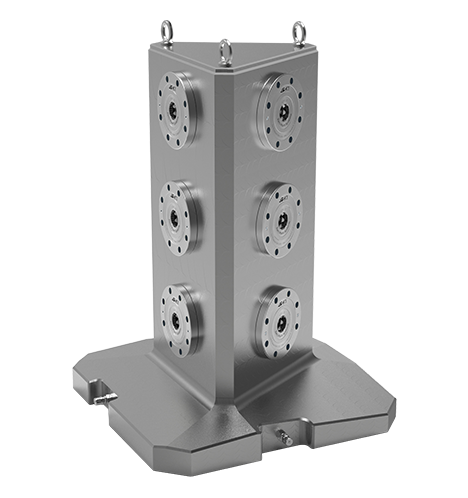 Triangle pillarRepeated positioning accuracy 0.005mm;View Product →
Once the base plate is chosen, match it with the correct locating pins, locking pins and pullers. These accessories are not generic bolts; they are precision components that define the final repeatability. Mixing parts from different series could lead to gaps and premature wear.
Integrating Vises and Clamping Systems for HMC Machining
The zero-point system holds the fixture, but the fixture must hold the workpiece. On an HMC, the combination of high cutting force and side approach means the vise or clamping unit needs to be rigid and easy to swap.
Manual vises still have a strong place in HMC work, especially when the batch size is small and the operator needs flexibility. A 96mm double-position vise can clamp two workpieces in one fixture, which increases the value of each HMC cycle. When the parts are symmetrical, the double position reduces the number of pallet exchanges needed per shift.
 96mm Double Position ViseRepeated positioning accuracy ±0.01mmView Product →
For more automated cells, pneumatic vises, manual ball lock systems and rollover fixtures can be combined with pallet quick-change systems. This creates a fully modular platform: zero-point base on the table, a quick-change pallet in the middle, and the vise or gripper on top.
Going Beyond Workholding: Quick-Change Tooling and Grippers
For HMCs used in complete manufacturing cells, the same quick-change logic can be applied beyond the workpiece. Tool shank quick-change systems with BT, Capto, HSK or hydraulic tooling reduce the time spent changing tools in the spindle. Quick-change grippers and pallet couplings help robots or loading systems move parts without manual setup.
A horizontal machining center becomes a true production unit when the workholding, tooling and handling systems are built around the same repeatable interface. Suzhou SET's product range covers zero-point systems, clamping systems, gripping systems and non-standard modules, so the entire chain can be designed consistently instead of mixing arbitrary components from different vendors.
What to Check Before Buying HMC Fixturing
Before purchasing zero-point workholding for an HMC, look at the table size, T-slot pattern, and the weight of your typical pallet. Confirm that the base plate's receiver units match the pallet's pullers. Check the clamping force and make sure it is sufficient for your high-force cuts. Ask about the delivery schedule and how quickly accessories such as locating pins and protection caps can be replaced.
Because the zero-point base plate is the foundation for many years of production, it is better to choose a proven supplier. Patent-protected designs and a service network can avoid costly downtime when a locking mechanism needs adjustment. The technical results shared by current users show that zero-point clamping systems reduce setup time by 90% and up, which is a strong reason to evaluate the full cost of the fixture system, not just the initial price.
Also plan for maintenance: keep the locating surface clean, protect the receivers from chips during machining, and store unused pallets on an air table or cart so that no debris enters the locking area.
Frequently Asked Questions
Q1: Can zero-point workholding be used on any horizontal machining center?
Most HMCs can accept zero-point systems. You only need to verify the table mounting pattern and the available z-height clearance. A base plate or column can be machined to match the worktable interface.
Q2: Should I choose a manual or a pneumatic system?
If you have a single operator changing fixtures by hand a few times per shift, a manual lock may be enough. For automated pallet changers or high-mix production, a pneumatic system allows remote and faster locking with lower physical effort.
Q3: How repeatable is positioning?
Repeatability is typically in the micrometer range when the locating pins, pullers and base plate are from the same system. The key is to keep the mating surfaces clean and avoid mixing components from different product lines.
Q4: What maintenance does a zero-point base plate need?
Regularly clean the locating bores, inspect the locking mechanism for wear, and replace damaged protective caps. Air-cleaning of the taper or ball-lock surface can reduce the risk of misalignment caused by chips.
latest news

- Horizontal Machining Centers: Cut Setup Time with Zero-Point Workholding
- Large Scale CNC Machining: How Workholding and Zero-Point Systems Maximize Output
- Air Gripper Selection Guide: Types, Grip Force, and Automation Integration
- CNC Pallet System Guide: How Zero-Point Pallet Quick Change Cuts Setup Time
Latest news
-
Large Scale CNC Machining: How Workholding and Zero-Point Systems Maximize OutputPicture a 1.4 m cast-iron housing sitting beside a horizontal machining center. The spindle can remove metal quickly, but the real bottleneck is everything before the first chip: lifting the blank, l...Read More
-
Air Gripper Selection Guide: Types, Grip Force, and Automation IntegrationA robot cell that runs five different part numbers in one shift is no longer unusual. The air gripper at the end of the arm picks and places, but when the product changes, the gripper often has to be...Read More
-
CNC Pallet System Guide: How Zero-Point Pallet Quick Change Cuts Setup TimeImagine a vertical machining center with the spindle stopped while the operator swaps a vise, indicates a fixture, and touches off three new tools. Fifteen minutes per changeover seems small until it...Read More
-
Pneumatic Workholding Solutions: How to Cut Your CNC Setup Time and ErrorsWorkholding is often the hidden time thief in a machining shop. A part that takes three minutes to clamp can turn a 30-second cycle into a 3-minute event, and across a shift that drains every hour of...Read More
-
Machine Tending Tools: How Quick-Change Grippers and Zero-Point Systems Cut CNC DowntimeA production manager watches the clock. The spindle stops, the operator walks over, waits for the table to unclamp, swaps a fixture, re-clamps, and starts the next part. That scene repeats several ti...Read More
Contact Details
- Address: 1-4 Floors, 17#03, Building 17, No. 269, Xinfeng Road, Xukou Town, Wuzhong District, Suzhou City
- Fax: +86-18112607008
- Tel: 18112607008
- Email: [email protected]
Mobile terminal
Copyright © SET Industrial | Zero-Point Positioning & CNC Workholding ALL RIGHTS RESERVED.