

 English
 русский
 Español
 简体中文
简体中文
A production manager watches the clock. The spindle stops, the operator walks over, waits for the table to unclamp, swaps a fixture, re-clamps, and starts the next part. That scene repeats several ti...
Read More
Machine Tending Tools: How Quick-Change Grippers and Zero-Point Systems Cut CNC Downtime
A production manager watches the clock. The spindle stops, the operator walks over, waits for the table to unclamp, swaps a fixture, re-clamps, and starts the next part. That scene repeats several times every shift, and each time it costs fifteen to thirty minutes of machine time. Machine tending tools are the equipment that removes this waste. They are not robots by themselves, but they are the components that let a robot or an operator move workpieces, pallets, and fixtures in and out of a CNC machine quickly and accurately.
This guide covers the practical categories of machine tending tools, from gripper quick-change devices to zero-point locators, and shows how to choose them without overcomplicating the setup.
What Are Machine Tending Tools?
Machine tending tools are the interface components that handle workpiece transfer, pallet exchange, fixture locating, and tool changeover around a CNC machine. The most common types include robotic grippers, gripper quick-change couplers, pallet quick-change systems, zero-point locators, base plates, and the small accessories that keep these systems aligned.
The conclusion is straightforward: the fastest way to cut CNC downtime is not a faster spindle. It is a more predictable interface. A well-designed machine tending setup combines three elements, a zero-point system on the machine table, a quick-change gripper on the robot or loader, and a pallet system that lets the operator stage work outside the machining envelope.
Core Categories of Machine Tending Tools
Gripper Quick-Change Devices
When one robot serves several machines, or one machine runs several part families, the end-of-arm tooling has to change often. A gripper quick-change device gives the robot a repeatable mechanical and pneumatic interface, so it can switch from a two-jaw gripper to a vacuum tool or a three-jaw chuck in seconds. The load rating defines the safe working range. A 75kg quick-change gripper works for medium-weight parts on common six-axis robots, while heavier workpieces force a move into the 100kg or 150kg classes.
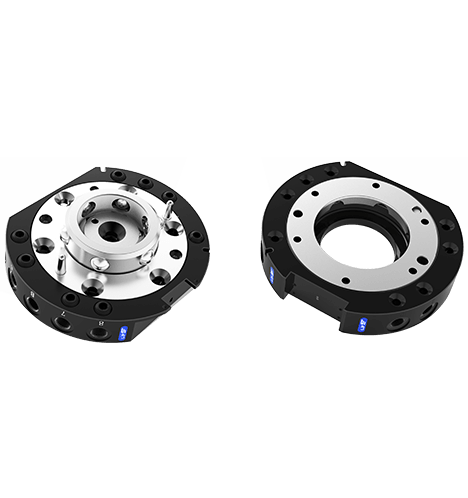 75kg Quick-Change Gripper with Precision RepeatabilityThis gripper handles 75kg payloads with ±0.015mm repeatability. Its self-locking mechanism prevents accidental gas loss, making it suitable for automated handling and assembly where frequent tool changes are needed.View Product →
The most common failure in this area is selecting a coupler based on the gripper weight alone. The calculation must include the gripper itself, the workpiece, and the dynamic forces from acceleration and deceleration.
Pallet Quick-Change Systems
A pallet system carries the workpiece from the loading station to the machining area on a standard pallet. The coupling unit is the part that locks the pallet onto the machine table or the tombstone. A pallet quick-change coupling must make the same clamping force at every cycle. More importantly, it should be self-locking, so the pallet stays clamped even if the air or hydraulic pressure drops.
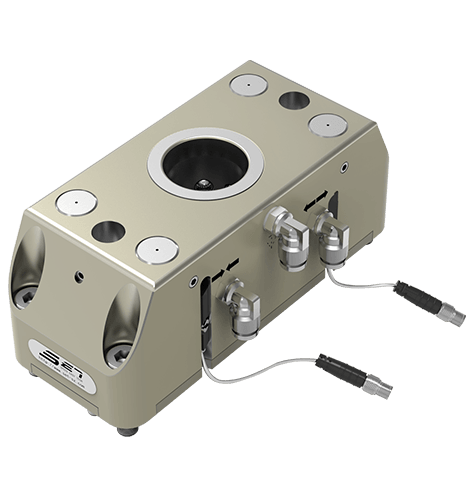 Self-Locking Pallet Coupling for Quick-Change SystemsThis coupling offers 0.02mm repeat positioning accuracy and 4kN clamping force. Pneumatic unlocking with mechanical self-locking ensures pallets stay clamped even if pressure drops, ideal for flexible manufacturing setups.View Product →
This solution is most productive when the shop runs a batch of identical parts, or when an operator can pre-load a second pallet while the first one is being machined. In those cases, the machine never has to wait for a manual setup.
Zero-Point Locators
Zero-point locators turn the machine table into a coordinate reference. Every fixture, pallet, or workpiece is positioned against the same locating points, and the clamping is released and re-applied through one actuation. The two main families are straight-column ball-lock and short-cone ball-lock. Straight-column versions cover most general machining tasks. Short-cone versions handle heavier loads and provide angular positioning. A flange-type automation zero locator is a compact unit that can be mounted directly on a fixture plate or a base plate for automatic operation.
Pairing a zero-point locator with a base plate turns a twenty-minute fixture change into a thirty-second swap. The operator still has to move the fixture, but the position is repeatable within microns, and the clamping signal comes from a single connection.
Supporting Accessories
Machine tending also depends on the smaller parts: locating pins, protection plugs, acceptance sleeves, and manual ball-lock components. These are easy to overlook, but they are the elements that wear out and that directly affect positioning accuracy over time. A worn locating pin or a loose acceptance sleeve will show up as inconsistent part quality and increased scrap.
How to Select Machine Tending Tools
Selecting the right tools starts with three numbers: workpiece weight, required repeatability, and the time available for changeover. The table below summarizes the main selection factors and what they mean for a production shop.
| Selection Factor | What to Look For | Practical Impact |
|---|---|---|
| Workpiece Weight | Gripper load rating must exceed workpiece plus gripper plus dynamic forces | Prevents dropped parts and robot damage |
| Positioning Repeatability | Zero-point locators targeting +/-0.005 mm or better | Keeps machining consistent across shifts |
| Current Changeover Time | Measure the time needed to swap a fixture before the purchase | Determines the payback period |
| Machine Table Geometry | T-slot size, table size, and available Z-axis height | Confirms the base plate or tombstone fits |
| Automation Readiness | Integrated pneumatic passages and sensor options | Enables automatic operation with a robot |
Before committing to a system, walk through the actual machine and check the air supply, the controller signals, and the clearance under the spindle. A zero-point base plate may be the right solution, but only if the machine table has room for it.
Manual or Automatic Machine Tending?
The choice between manual and automatic tools is not about what is more modern. It is about what the machine time is worth.
Manual systems, such as a manual ball-lock coupler or a manual pallet locator, are inexpensive and easy to maintain. They are ideal for job shops where the machine runs different workpieces every day and no robot is present. The operator still has to reach into the machine, but the mechanism is faster and more repeatable than a traditional T-slot clamp.
Automatic systems, such as pneumatic zero-point locators and gripper quick-change devices, are designed for unattended machining. They allow the robot or the pallet transfer system to trigger the clamping signal through the machine control. The initial investment is higher, but the savings show up when a cell runs overnight or when one operator handles three machines.
A practical approach for many shops is to start with a manual zero-point system and add automation later. A three-axis zero-point quick-change application is a good example of a step that does not require a robot. The same zero-point clamping concept can reduce setup time by ninety percent compared with traditional T-slot fixturing.
Implementation Pitfalls to Avoid
Even with the right components, a poorly integrated machine tending setup can underperform. Watch for these issues.
- Overlooking dynamic forces: A gripper that handles the static weight but not the acceleration force will drop parts during rapid moves. Always calculate the total load and add a safety factor.
- Ignoring the air supply: Pneumatic zero-point locators need a clean, dry air supply and the correct pressure range. Water or oil in the lines will ruin the clamping repeatability.
- Mixing base plates from different systems: A base plate and a coupling must match in dimensions, locating pin position, and pull-down mechanism. Mixing them causes misalignment and inconsistent clamping.
- Not measuring the whole cycle: Track the entire sequence from unclamping to re-clamping before and after the change. This includes pallet travel, locating, and the clamp signal.
One additional point: the fixture itself still matters. A zero-point locator can only be as accurate as the fixture it holds. If the workpiece is clamped incorrectly in the fixture, the repeatability of the locator will not save the part.
Frequently Asked Questions
Q1: What is the difference between manual and automatic machine tending tools?
Manual tools require the operator to release and engage the clamping mechanism by hand. Automatic tools are actuated by pneumatic or hydraulic pressure and can be triggered by the machine control or the robot. Automatic tools become worthwhile when the machine runs unattended for long cycles or when changeovers happen frequently across multiple shifts.
Q2: Can machine tending tools be retrofitted to existing CNC machines?
Yes. Zero-point locators, base plates, and pallet couplings can be installed on standard machine tables, tombstones, and vices. The main requirements are enough table space, sufficient Z-axis clearance, and an available air supply for the clamping signal.
Q3: How much repeatability can a zero-point locator provide?
Good zero-point systems typically provide repeatability of +/-0.005 mm or better. That range is sufficient for most machining operations, from roughing passes to finishing cuts where the fixture position must remain identical every cycle.
Q4: How long does it take to see a return on this investment?
Add up the setup time each day, convert it to the machine rate, and compare it to the cost of the tooling and integration. For a shop running two shifts, the payback usually lands between twelve and twenty-four months. For high-mix, low-volume work where changeovers happen several times a day, the payback can be much shorter.
latest news

- Machine Tending Tools: How Quick-Change Grippers and Zero-Point Systems Cut CNC Downtime
- Machine Tending Fixtures: Key Factors Behind a Stable CNC Machining Cell
- 5-Axis Workholding: How Zero-Point Systems and Vises Maximize Machining Stability
- How Do Locating and Alignment Accessories Define CNC Machining Accuracy?
Latest news
-
Machine Tending Fixtures: Key Factors Behind a Stable CNC Machining CellThe night shift operator calls maintenance before the robot has run for an hour. The arm comes down to the same teach point every cycle, but the part is 0.03 mm off in the fixture. Within minutes the...Read More
-
5-Axis Workholding: How Zero-Point Systems and Vises Maximize Machining StabilityA five-axis machining center is only as good as the workholding that supports it. A fixture that blocks the rotary table or interferes with the cutter path turns a five-axis machine into a three-axis...Read More
-
How Do Locating and Alignment Accessories Define CNC Machining Accuracy?Introduction: The Hidden Cost of Misalignment In CNC machining, the difference between a high-value precision component and a scrap part often comes down to a fraction of a millimeter. While spindles...Read More
-
What Clamping System Delivers the Best Accuracy and Throughput for Your Vertical Machining Centre?Why Clamping Systems Define VMC Performance In vertical machining centres, the clamping system is not a passive accessory—it is the structural link between the machine spindle and the workpiece. A ri...Read More
-
What Is the Fastest Way to Reduce CNC Setup Time with Pallet, Gripper, or Manual Quick Change Devices?In high‑mix CNC production, setup time is the largest controllable drag on throughput. Pallet Quick Change Systems, Gripper Quick Change Devices, and Manual Quick Change Devices each address specific...Read More
If you are interested in our products, please consult us
Contact Details
- Address: 1-4 Floors, 17#03, Building 17, No. 269, Xinfeng Road, Xukou Town, Wuzhong District, Suzhou City
- Fax: +86-18112607008
- Tel: 18112607008
- Email: [email protected]
Products
Quick Link
News Center
Mobile terminal
Copyright © SET Industrial | Zero-Point Positioning & CNC Workholding ALL RIGHTS RESERVED.