

 English
 русский
 Español
 简体中文
When a 500 kg cast housing reaches a 5-axis machining center, the real test begins before the spindle starts. The B-axis tilts the part, gravity shifts the load, and the cutting tool changes directio...
Read More
Heavy Part 5-Axis CNC Machining: Key Workholding and Zero-Point Solutions
When a 500 kg cast housing reaches a 5-axis machining center, the real test begins before the spindle starts. The B-axis tilts the part, gravity shifts the load, and the cutting tool changes direction with every pass. The workholding system has to resist all of it. For heavy parts, workholding is not just a fixture choice. It is the difference between reliable production and repeated scrapping.
Shops that treat heavy 5-axis work as a machine capability question often miss the bigger issue. The machine can reach every face of the part. The question is whether the fixture can hold it safely and repeatably for as long as the job takes.
Why Heavy Parts Create Different Dynamics on 5-Axis Machines
Heavy parts behave differently from lighter workpieces on 5-axis machines in three important ways.
Center of gravity shifts. When the tilting axis moves, the part's center of gravity changes position relative to the table. This generates a moment that pulls against the fixture. A 200 kg part hanging 200 mm off-center produces a force that can loosen undersized clamps.
Cutting forces change direction. In simultaneous 5-axis machining, the tool orientation changes continuously. Cutting loads alternate direction and magnitude. The fixture has to absorb this without allowing micro-movement or chatter.
Setup time compounds. Repositioning a heavy part is expensive and requires a crane or handling equipment. A workholding system that allows repeatable setup without re-indicating is essential for keeping heavy 5-axis jobs profitable.
The consequence is simple: if the fixture does not hold the part rigidly enough, the machining accuracy, surface finish, and tool life all suffer. Large parts also create a higher risk of damaging the machine table or the fixture itself when something goes wrong.
Three Workholding Foundations for Heavy Part 5-Axis Machining
There are three complementary layers to a reliable workholding setup for heavy 5-axis components. Most shops that run heavy jobs successfully use all three in combination.
Zero-Point Systems for Repeatable Positioning
A zero-point system is the interface between the machine table and the fixture. It locks the setup into a defined position with high repeatability. For heavy parts, this matters because you can load a heavy part once and keep the reference for every operation, change fixtures between jobs without re-indicating, and use the same base plate across multiple 5-axis machines.
When handling large parts, the clamping and release function is crucial. A pneumatic built-in pneumatic built-in zero-point locator provides automatic clamping without requiring an operator to manually tighten a large, awkward bolt. This is especially useful when the part weight makes manual clamping impractical.
Modular Base Plates for Rigidity
Base plates distribute the fixture across the machine table. For heavy parts, rigidity is the main concern. A larger base plate with multiple locating points spreads the load and reduces deflection under cutting forces and the part's own weight.
A 630-800mm foundation board is a practical choice for medium-heavy components in most 5-axis machining centers. If you are machining very large castings or weldments, a 1200mm foundation board provides a wider platform that reduces the risk of overhang and bending, particularly when the fixture is mounted on a rotary table.
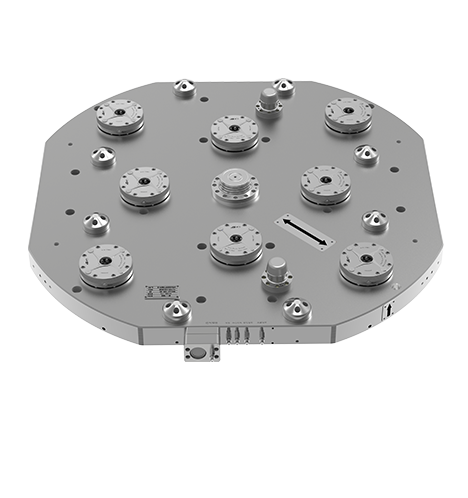 1200mm Stainless Steel Foundation Board for Large CastingsThis 1200mm wide platform provides 0.015mm repeat positioning, 136kN clamping force, and reduces bending risk for large castings or weldments on rotary tables, ensuring stable machining.View Product →
 630mm Stainless Steel Foundation Board for Medium-Heavy ComponentsThis 630mm base plate offers 0.01mm repeat positioning accuracy and 85kN clamping force, making it a reliable choice for medium-heavy parts on 5-axis centers. Use it to avoid overhang and maintain rigidity.View Product →
The key is to match the base plate size and locating pattern to both the machine table and the part envelope. Overhang creates leverage, and leverage defeats rigidity.
Heavy-Duty Vises and Clamping
Vises handle direct workpiece clamping. For heavy parts, the vise must have sufficient clamping force and a solid engagement area. Pneumatic vises offer consistent pressure, while manual vises with ball-lock mechanisms provide simple, reliable setups that are easy to swap between jobs.
For very large workpieces, you often need custom jaws or special fixture plates. In those cases, a non-standard solution that combines a base plate with custom jaws gives the best balance of repeatability and direct clamping force.
Comparing 3-Axis, 3+2, and Simultaneous 5-Axis for Heavy Parts
The choice of machining strategy changes the demands on the workholding system. For heavy components, the pragmatic solution is frequently 3+2 machining rather than full simultaneous 5-axis.
| Criterion | 3-Axis | 3+2-Axis | Simultaneous 5-Axis |
|---|---|---|---|
| Setup time | Frequent repositioning | Fewer setups | Fewest setups |
| Workholding demand | Standard fixtures | Zero-point fixtures | High-rigidity fixtures |
| Best for heavy parts | Simple flat components | Multi-face parts | Complex contoured parts |
| Primary risk | Position error stacking | Tool interference | Fixture instability |
For heavy parts that require features on multiple faces, 3+2 machining with a five-axis zero-position quick change setup gives you the access you need without requiring the fixture to handle continuously changing tool contact angles. Simultaneous 5-axis still offers the best surface finish and complex-geometry capability, but the workholding has to be exceptionally rigid to handle the dynamics.
Key Specs to Evaluate Before Buying Workholding for Heavy Parts
When you compare workholding options for heavy 5-axis jobs, you should evaluate these criteria before making a purchase decision. The practical difference between a good and bad workholding system often shows up after the first heavy part is loaded.
| Criterion | Why It Matters | What to Look For |
|---|---|---|
| Repeatability | Reduces alignment time | 0.005 mm or better |
| Clamping force | Prevents movement | Rated force values, not vague claims |
| Rigidity | Improves surface finish | No thin sections in the fixture |
| Quick-change capability | Reduces downtime | Single-action locks, standard interface |
Reality check: A fixture rated for 500 kg does not automatically handle 500 kg on a tilted table. The moment created by the center of gravity can easily exceed the clamping force of a system that works fine on a flat table.
You should also consider how the workholding system interacts with the machine's rotary table. A small zero-point interface can be a bottleneck for heavy parts if the base plate is too small for the part's footprint. Check the machine table capacity, the part weight, and the fixture weight together, not separately.
Common Mistakes in Heavy Part 5-Axis Workholding
Even with solid equipment, shops still make errors that lead to scrapped parts or damaged fixtures. These mistakes are avoidable if you know what to look for.
- Underestimating the center of gravity. A heavy part on a tilted table creates a moment that flexes the fixture. Use a wider base or add more locating points rather than relying on clamp force alone.
- Using the same fixture for all part sizes. A one-size-fits-all fixture usually does not work for heavy parts. Mass and geometry change the load profile in ways that a small-part fixture cannot handle.
- Ignoring table capacity. If the machine table is rated for 1,000 kg, do not load it with 900 kg of part plus 200 kg of fixture. You need headroom for cutting forces and safety.
- Skipping verification runs. For the first heavy part in a new setup, a low-speed test pass may reveal fixture flex before it becomes an expensive problem.
A strong foundation is the starting point. When the setup is repeatable and rigid, you avoid the most common source of errors in heavy 5-axis work. For a deeper explanation of how zero-point systems improve workpiece stability in 5-axis CNC machining, reviewing application data from similar jobs is a useful step before committing to a fixture design.
FAQ
Q1: What is the biggest challenge in heavy part 5-axis CNC machining?
The biggest challenge is maintaining rigidity and repeatability. As the part rotates, the center of gravity shifts, and cutting forces act in changing directions. The workholding system must resist both the part's weight and the cutting loads without moving.
Q2: Can zero-point systems handle very heavy parts?
Yes, when properly sized. A zero-point locator with a large enough base plate and multiple locking pins can handle heavy parts, but you need to match the system to your part weight and cutting loads. Check the rated clamping force and the number of locating points before selecting.
Q3: Is 3+2 machining better than simultaneous 5-axis for heavy parts?
Often, yes. 3+2 machining indexes the part to fixed positions, which reduces the complexity of the workholding. Simultaneous 5-axis offers more freedom but demands more from the fixture. For heavy parts, 3+2 is usually the safer and more productive choice.
Q4: How do I know if my current workholding is strong enough for a new heavy part?
First, calculate the cutting forces and the moment created by the part's weight when the table is tilted. Compare that against the rated clamping force of your fixture. If the margin is thin, upgrading to a more rigid base plate or adding more locating points is the right move.
latest news
- Heavy Part 5-Axis CNC Machining: Key Workholding and Zero-Point Solutions
- Horizontal Machining Centers: Cut Setup Time with Zero-Point Workholding
- Large Scale CNC Machining: How Workholding and Zero-Point Systems Maximize Output
- Air Gripper Selection Guide: Types, Grip Force, and Automation Integration
Latest news
-
Horizontal Machining Centers: Cut Setup Time with Zero-Point WorkholdingThe Real Bottleneck on Horizontal Machining Centers A horizontal machining center (HMC) can run continuously through faces of a part, but the hours lost between jobs are what often hurt the productio...Read More
-
Large Scale CNC Machining: How Workholding and Zero-Point Systems Maximize OutputPicture a 1.4 m cast-iron housing sitting beside a horizontal machining center. The spindle can remove metal quickly, but the real bottleneck is everything before the first chip: lifting the blank, l...Read More
-
Air Gripper Selection Guide: Types, Grip Force, and Automation IntegrationA robot cell that runs five different part numbers in one shift is no longer unusual. The air gripper at the end of the arm picks and places, but when the product changes, the gripper often has to be...Read More
-
CNC Pallet System Guide: How Zero-Point Pallet Quick Change Cuts Setup TimeImagine a vertical machining center with the spindle stopped while the operator swaps a vise, indicates a fixture, and touches off three new tools. Fifteen minutes per changeover seems small until it...Read More
-
Pneumatic Workholding Solutions: How to Cut Your CNC Setup Time and ErrorsWorkholding is often the hidden time thief in a machining shop. A part that takes three minutes to clamp can turn a 30-second cycle into a 3-minute event, and across a shift that drains every hour of...Read More
Contact Details
- Address: 1-4 Floors, 17#03, Building 17, No. 269, Xinfeng Road, Xukou Town, Wuzhong District, Suzhou City
- Fax: +86-18112607008
- Tel: 18112607008
- Email: [email protected]
Mobile terminal
Copyright © SET Industrial | Zero-Point Positioning & CNC Workholding ALL RIGHTS RESERVED.