

 English
 русский
 Español
 简体中文
简体中文
Picture a 1.4 m cast-iron housing sitting beside a horizontal machining center. The spindle can remove metal quickly, but the real bottleneck is everything before the first chip: lifting the blank, l...
Read More
Large Scale CNC Machining: How Workholding and Zero-Point Systems Maximize Output
Picture a 1.4 m cast-iron housing sitting beside a horizontal machining center. The spindle can remove metal quickly, but the real bottleneck is everything before the first chip: lifting the blank, locating it, clamping it without distortion, and guaranteeing the same position on the next pallet. In large scale CNC machining, workholding and datum repeatability decide the outcome before the tool touches the part.
The practical conclusion: shops that handle large components get the most benefit from base plates, zero-point systems, and pallet quick-change equipment, not from a faster spindle.
This article explains what makes large-scale work different, where the cost actually hides, and how to build a workholding strategy around it.
What Large Scale CNC Machining Really Involves
There is no single official definition, but most shops use three criteria: a workpiece envelope beyond roughly 600 mm in any direction, a part mass above 150-300 kg, or operations on machines with pallets of 630 mm and larger. A 2-ton pump housing, a 3 m weldment, or a 1.6 m ring on a vertical lathe are typical examples.
| Machine platform | Common part envelope | Workholding priority | Typical sector |
|---|---|---|---|
| Large horizontal machining center | 630-1,200 mm pallets, parts up to several tonnes | Pallet coupling, rigid base plate, zero-point repeatability | Heavy machinery, energy |
| Gantry or bridge mill | Parts above 2,000 mm | Modular locating points, large foundation boards | Aerospace, tooling |
| Vertical lathe (1-6 m) | Large diameters, heavy castings and weldments | 4-6 point zero-point locating, high pull-down force | Steel, pumps, valves |
| 5-axis machining center | Complex prismatic housings | Tombstone with zero-point base plate, clamping sensors | Die and mold, aerospace |
The move from small parts is not just a matter of size. On large workpieces, clamping forces interact with part stiffness, every error costs more, and each setup consumes expensive machine time. That is why the workholding plan has to be deliberate rather than improvised.
Why Large Workpieces Fail During Setup Instead of During Cutting
Most quality problems on large scale CNC machining appear before the spindle starts. The part is heavy, the surfaces are rough, and the setup is hard to repeat.
- Weight and stability. A 500 kg workpiece with a high clamping point creates leverage; interrupted cuts transfer that leverage into vibration.
- Clamping distortion. Large castings and weldments are rarely perfectly flat. Clamping a twisted flange flat at the wrong points bends the part, and the machining result moves when the part is released.
- Datum loss between operations. A large part often needs op10 and op20. If the second operation uses a different reference, the error repeats or grows.
- Long non-cutting time. Crane lifting, cleaning, indicating, and clamping can consume 30-90 minutes per setup on big workpieces.
On large scale CNC machining, setup time and datum repeatability usually outweigh spindle power in the cost calculation.
Zero-Point Clamping: The Backbone of Large-Part Workholding
Zero-point clamping replaces manual indicating with a mechanical interface. The workpiece or fixture locks into the same locator every cycle, returning to the same position within the system's specified repeatability; for a well-built system, nominally 0.005 mm or better. On a large machining center, this is the difference between a 40-minute setup and a repeatable five-minute exchange.
Large parts also need support in more places. A long workpiece resting on only two or three locating points will flex under its own weight and amplify vibration during heavy cuts. The practical rule is to spread the locating points across the footprint using a machined base plate with four, six, or eight units. This is where foundation-board selection becomes more important than any single clamp.
On a five-axis machine, the same principle protects the relationship between the part and the rotary axis. A well-referenced pallet or fixture keeps the datum stable while the machine reorients the part. See how this is handled in the five-axis zero-position quick-change application.
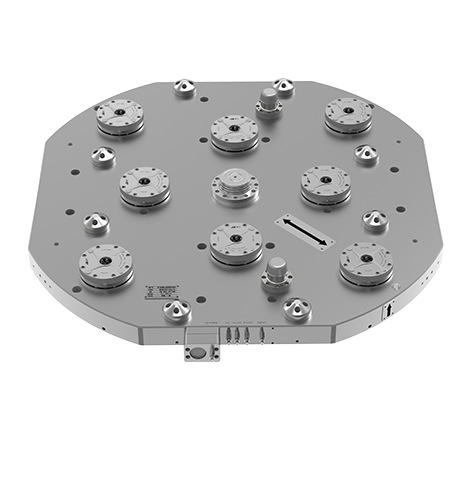 1200 mm Stainless Steel Foundation Plate for Five-Axis Zero-Point SystemsProvides a continuous reference surface for long machine tables or large tombstones, with 0.015 mm repeatability and high clamping force, suitable for five-axis and machine tool processing.View Product →
For machines with long tables or large tombstones, a 1,200 mm foundation plate gives the part a continuous reference surface instead of a set of floating points.
Pallet Exchange and Quick Change: Where the Savings Are
In a large-scale CNC machining cell, the pallet is the production unit. The goal is to keep the spindle cutting while the next part is being prepared outside the machine. A pallet quick-change system couples the tray to the machine table and releases it when the cycle is finished; combined with zero-point locating, the pallet returns to a known position without re-indicating.
60-90% setup time reduction commonly reported after converting to zero-point pallet change
0.005 mm repeatable locating typical of quality zero-point interfaces
4-8 units locating points recommended for large base plates and tombstones
For a shop running small batches of heavy parts, the economic case is machine-hour recovery. The non-cutting time moves out of the machine, and the operator prepares the next blank while the current one is being machined. Detailed comparisons of this effect are covered in the article on how zero-point clamping systems reduce setup time by as much as 90 percent.
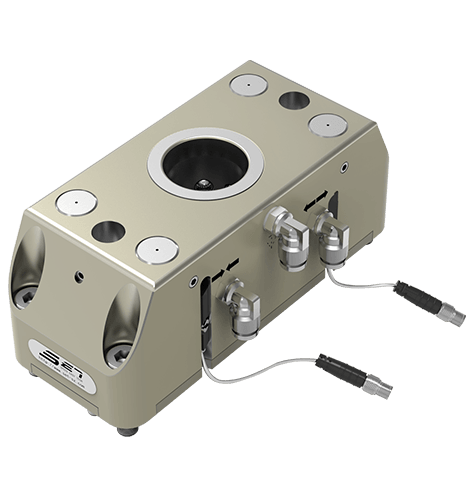 Pneumatic-Release Coupling with Self-Locking MechanismOffers quick workholding changes for small batches of heavy parts, featuring 0.02 mm repeat position accuracy and built-in detection interfaces for automated multi-axis robot handling.View Product →
Choosing Base Plates and Clamping Systems for Large Parts
The right workholding architecture depends on three variables: part size, batch size, and how much of the process you want to automate. The table below summarizes the usual choices.
| Workholding solution | Best for | Main trade-off |
|---|---|---|
| Dedicated fixture on zero-point base plate | Long series of one large part | Higher initial fixture cost, best rigidity |
| Tombstone with zero-point base plates | Several part numbers on one horizontal machining center | Needs pallet handling and careful weight balance |
| Pallet quick-change coupling with tray adapter | Machining cells running multiple pallets | Requires clean air supply and planned maintenance |
| Manual ball-lock and manual quick-change devices | Inspection stations, preset stations, secondary operations | Manual operation, lower cost, good for low-frequency changes |
Verification signals for unattended large-part clamping
As soon as a large machine runs with reduced supervision, you need a signal that every locating point is actually locked. A flange-type zero positioner with sensor feedback closes that loop: the machine only starts when the fixture reports full clamping. This matters most on pallets that travel between a load station and the machining area.
A Practical Procedure for Large-Part Fixturing Plans
- Define the datum scheme from the finished geometry, and place the locators as far apart as the part allows.
- Choose the number of locating units (commonly four, six, or eight) to control all six degrees of freedom without over-constraining the blank.
- Calculate the clamping force and direction; clamp into stiff ribs and webs, not into thin walls or unsupported flanges.
- Select the base plate size based on the machine table, the part footprint, and chip clearance.
- Add position sensors if the process runs unattended or if the fixture is exchanged between machines.
- Prove the setup with a trial part and on-machine probing before releasing it to production.
Common Mistakes That Raise Cost on Large-Scale CNC Parts
- Using an oversized plate on a small coupler. The leverage turns every cutting force into vibration.
- Clamping the overhang instead of supporting it. A support under the overhang is worth more than a stronger clamp on top.
- Letting chips and coolant collect in the locators. Zero-point interfaces stay accurate only when the seating faces are clean.
- Skipping the clamped/unclamped signal. On a heavy pallet, a half-locked coupler is hard to see and expensive to crash.
- Optimizing setup speed without measuring repeatability. Saving five minutes per change matters less than holding the datum within tolerance.
Frequently Asked Questions
What zero-point base plate sizes are available for large machines?
Common sizes include 250/300/400 mm, 630/800 mm, 800/1,000 mm, and 1,200 mm foundation boards, with two, four, six, or eight locating units. The choice depends on the part footprint and the machine table.
Can a zero-point system hold a workpiece heavier than one tonne?
Yes, when the load is distributed over multiple locating units on a rigid base plate. The practical limit depends on the number and rating of the units, the base plate stiffness, and the machine table interface.
How many zero-point units should a large base plate use?
For large rectangular parts and tombstones, four to eight units are common. More units improve support, but the mounting surface must be machined flat so that all units share the load evenly.
Should I choose manual or pneumatic systems for large parts?
Pneumatic zero-point systems are faster and easier to automate, which suits pallet exchange and high-frequency changeover. Manual ball-lock and manual quick-change devices make sense for inspection stations, preset stations, and secondary operations where speed is not critical.
Large scale CNC machining rewards discipline in workholding. A machined base plate, enough zero-point locating points, and a pallet exchange strategy do more than reduce setup time; they keep the part correct from the first operation to the last. For a blank weighing half a tonne, that is the difference between a controlled process and a daily gamble.
Start from the finished geometry, work back to the locating points, and let the machine table do what it does best: cut metal.
latest news

- Large Scale CNC Machining: How Workholding and Zero-Point Systems Maximize Output
- Air Gripper Selection Guide: Types, Grip Force, and Automation Integration
- CNC Pallet System Guide: How Zero-Point Pallet Quick Change Cuts Setup Time
- Pneumatic Workholding Solutions: How to Cut Your CNC Setup Time and Errors
Latest news
-
Air Gripper Selection Guide: Types, Grip Force, and Automation IntegrationA robot cell that runs five different part numbers in one shift is no longer unusual. The air gripper at the end of the arm picks and places, but when the product changes, the gripper often has to be...Read More
-
CNC Pallet System Guide: How Zero-Point Pallet Quick Change Cuts Setup TimeImagine a vertical machining center with the spindle stopped while the operator swaps a vise, indicates a fixture, and touches off three new tools. Fifteen minutes per changeover seems small until it...Read More
-
Pneumatic Workholding Solutions: How to Cut Your CNC Setup Time and ErrorsWorkholding is often the hidden time thief in a machining shop. A part that takes three minutes to clamp can turn a 30-second cycle into a 3-minute event, and across a shift that drains every hour of...Read More
-
Machine Tending Tools: How Quick-Change Grippers and Zero-Point Systems Cut CNC DowntimeA production manager watches the clock. The spindle stops, the operator walks over, waits for the table to unclamp, swaps a fixture, re-clamps, and starts the next part. That scene repeats several ti...Read More
-
Machine Tending Fixtures: Key Factors Behind a Stable CNC Machining CellThe night shift operator calls maintenance before the robot has run for an hour. The arm comes down to the same teach point every cycle, but the part is 0.03 mm off in the fixture. Within minutes the...Read More
Contact Details
- Address: 1-4 Floors, 17#03, Building 17, No. 269, Xinfeng Road, Xukou Town, Wuzhong District, Suzhou City
- Fax: +86-18112607008
- Tel: 18112607008
- Email: [email protected]
Mobile terminal
Copyright © SET Industrial | Zero-Point Positioning & CNC Workholding ALL RIGHTS RESERVED.