

 English
 русский
 Español
 简体中文
简体中文
The Real Bottleneck on Horizontal Machining Centers
A horizontal machining center (HMC) can run continuously through faces of a part, but the hours lost between jobs are what often hurt the productio...
Read More
Machine Tending Fixtures: Key Factors Behind a Stable CNC Machining Cell
The night shift operator calls maintenance before the robot has run for an hour. The arm comes down to the same teach point every cycle, but the part is 0.03 mm off in the fixture. Within minutes the cell has produced three scrap parts and the operator has stopped the line to check the locating pin. In most machine tending cells, this is the pattern that reveals the real bottleneck: fixture repeatability, not robot motion.
Machine tending fixtures include zero-point locators and base plates, pallet quick-change systems, manual and pneumatic vises, gripper quick-change devices, and the locating pins and pullers that keep the interface stable. Their job is to define a reference point shared by the robot, the workpiece, and the machine table on every cycle. If the fixture cannot return to the same position each time, the robot cannot become productive. If it blocks gripper access, cycle time rises. If it is not self-locking when air pressure drops, the cell becomes a safety risk.
What a Machine Tending Fixture Must Deliver
Three performance requirements decide whether a tending fixture is fit for the job.
- Positioning repeatability. A zero-point locator should return a pallet or workpiece to within 0.005 mm to 0.01 mm of the same location on every cycle. If the locator drifts to 0.02 mm, the machine can still cut, but the finished part is likely to fail a 0.025 mm inspection tolerance.
- Stable clamping force. The clamp must resist cutting forces without springback, and the preload should stay consistent from part to part. A manual vise needs a repeatable torque setting, while a pneumatic zero-point system keeps the force automatic the same.
- Unobstructed robot access. The fixture must leave room for gripper fingers, part sensors, and chip clearance. If the robot has to approach from an awkward angle, the program adds a safe distance that stretches every cycle.
Repeatability is not a feature. It is the baseline that makes all other automation benefits possible.
Zero-Point Systems as the Tending Foundation
The fastest way to make a machine tending cell repeatable is to mount the workholding on a zero-point base plate. The base plate is bolted to the machine table or tombstone and carries multiple locators. Once it is trammed, every pallet or fixed fixture that seats on it locks into the same reference point.
Choose the base plate size first
The foundation board must match the table envelope and the pallet size. A 250/300/400 mm foundation board is a common choice for small and medium machining centers. For larger pallets or tombstones, 630/800 mm and 800/1000 mm boards offer wider locator spacing and more mounting options. The board also needs to keep its flatness under repeated clamping, so material quality and machining accuracy matter as much as the dimensions.
Match the locator to the cutting load
Straight column ball-lock locators handle most general machining tasks. Short cone ball-lock locators give higher radial stiffness and a faster seating stroke, which helps when the robot places the pallet quickly. Octagonal taper locators provide a larger contact area and better damping for five-axis work where cutting forces change direction. The five-axis zero point quick change application case shows how the locator pattern supports this kind of setup.
A zero-point base plate also reduces manual interventions. When the cell changes from one job to the next, the operator swaps the pallet instead of re-tramming the fixture. That swap takes seconds, and the robot can resume loading without waiting for a setup check.
Zero-point locator foundation board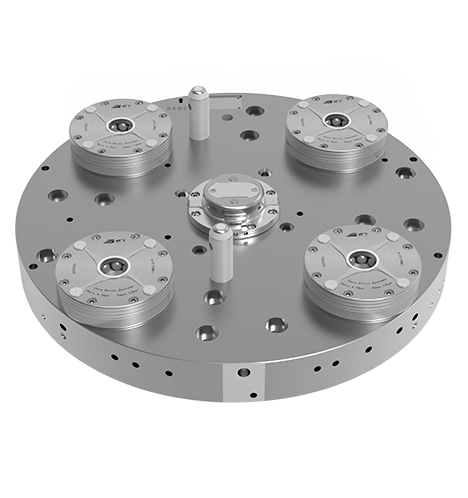 550mm Stainless Steel Zero-Point Base Plate for Machine TendingThis 550mm foundation plate provides 0.01mm repeatability and 78kN clamping force, enabling rapid pallet swaps and reducing setup time. Ideal for CNC cells that require precise, repeatable positioning.View Product →
Robot Handoff: Gripper and Pallet Interfaces
The robot end of the cell needs the same discipline as the workholding end. A gripper quick-change device keeps the mechanical reference between the robot flange and the end-effector identical after every tool change. Without it, a worn jaw or a damaged gripper becomes a long stoppage.
For most CNC tending loads, a 75 kg gripper quick-change device offers enough payload reserve for a medium-sized blank plus the tooling weight. It also supports an electrical module, which is important when the end-effector needs a sensor signal to confirm that the part was picked.
75 kg gripper quick-change device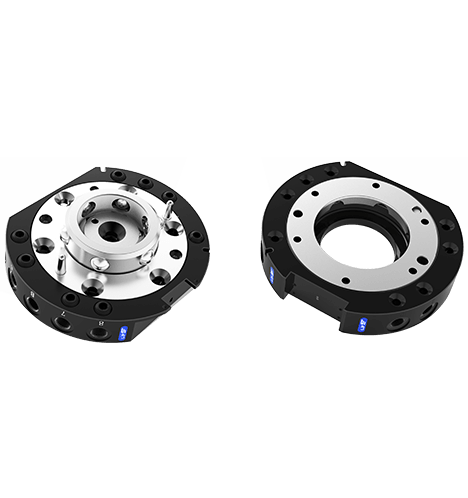 75kg Pneumatic Quick-Change Gripper with Optional ModulesDesigned for medium payloads, this gripper offers ±0.015mm repeatability and 7400N locking force. Supports power and signal modules for reliable part pickup in automated tending cells.View Product →
On the pallet side, a pallet quick-change system lets the robot load raw parts onto carriers outside the machine. The carrier moves into the zero-point base plate, the machine cuts the part, and the carrier leaves with the finished piece. This works especially well for small parts that are hard to grip directly at the spindle. The nonstandard automated manipulator end example illustrates how a custom interface can combine pallet coupling and gripper exchange in the same cell.
One rule to keep: the gripper must seat with the same pull-down force every time. If the robot cannot verify the handoff position, add a sensor in the fixture or the gripper so the program stops before a misaligned part enters the cut.
Manual or Automated Changeover: Where Each Wins
Automation does not always mean removing manual workholding. Many reliable tending cells use a manual vise on a zero-point base plate, and the robot simply loads parts into the same vise each cycle. The difference is in the production pattern.
- High-volume, low-mix: Automated pallet handling wins. A base plate with many pallets lets the cell run unattended for hours, and the changeover is nested inside the pallet system.
- High-mix, low-volume: A manual vise with a ball-lock locator wins. It costs less, is easier to maintain, and lets the operator switch parts in seconds without touching the base plate.
- Lights-out or unattended: You need automated pallet handling and a gripper interface the robot trusts. No operator is around to correct a slipping clamp or a misplaced part.
A 96 mm simplex manual vise is a good starting point for medium-sized blanks. The large jaw opening accepts a range of workpiece widths, and the body is rigid enough for light and medium milling. When it is mounted on a zero-point base plate, the robot can pick up the part from the same location every time, even if the operator changes the jaw position between jobs.
96 mm simplex manual vise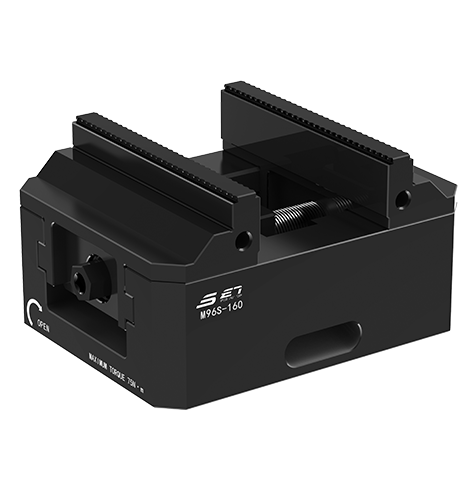 96mm Manual Simplex Vise for Medium BlanksA rigid vise with 266mm jaw opening and 15kN clamping force, suitable for blank, smooth, or dovetail workpieces. When mounted on a zero-point plate, it ensures consistent part location for robot loading.View Product →
Selection Criteria That Actually Matter
Five criteria decide whether a machine tending fixture will hold up over months of production. Check them before ordering.
- Machine table size and locator pattern. Measure the T-slots or grid holes. The base plate must fit without overhang, and the locator spacing must match your pallet system. A mismatch here creates a cell that cannot be standardized.
- Workpiece geometry and datum. Use three locating points for irregular castings, two for flat surfaces, and one for a round blank. The datum must be accessible to the gripper without the robot having to flip the part.
- Cutting force and rigidity. A roughing pass in steel produces lateral force that can shift a fixture. Calculate the worst-case tool load, then choose a clamping approach with enough preload to resist it without damaging the part surface.
- Tolerance stack-up. The total error includes the base plate, the locator, the workpiece, and the gripper. If the sum exceeds 0.03 mm, a part with 0.05 mm tolerance cannot be produced reliably, no matter how accurate the machine spindle is.
- Maintenance and chip clearance. Chips will reach every fixture. Choose locators, pullers, and protective plugs that clean easily and resist cutting fluid. A plugged locator cavity changes the seating point and ruins repeatability.
Standardizing the interface across the fleet is another practical point. If one machine uses a straight column locator and another uses a short cone, you need two different pallets and spare parts. A common interface makes operator training and spare-parts inventory manageable.
Safety and Operator Recovery
A fixture also has a safety role. In a manual cell, it keeps the workpiece fixed while the operator works nearby. In an automated cell, it must fail in a predictable way when power or air is lost.
Spring-loaded locking designs hold the workpiece even with air off. A ball-lock with a mechanical self-locking action gives you this without adding complex sensors. For pneumatic systems, add a pressure switch and build a fault condition into the robot program so the robot does not unload a part that is not securely clamped.
Operator recovery is often overlooked. A fixture that gives clear visual feedback, such as a visible clamp position or a sensor indicator, turns a stalled cell into a one-minute fix instead of a wait for the maintenance team.
Machine Tending Fixture FAQ
Q1: What is a machine tending fixture?
It is the workholding or interface component that positions and clamps a part or pallet during robot-assisted loading and unloading. It includes zero-point base plates, locators, vises, pallet systems, gripper quick-change devices, and locating pins.
Q2: How much repeatability does a machine tending fixture need?
For most CNC milling, 0.01 mm or better is a safe target. If the part tolerance is 0.02 mm, the fixture stack needs to hold below 0.01 mm, because the machine axis, thermal drift, and tool wear all add variation.
Q3: Can I retrofit my existing manual vises for robotics?
Yes. Mount the vise on a zero-point base plate and keep the jaw position fixed. The robot then places the part into the same seat every cycle. The main requirement is that the robot can reach the part without colliding with the vise body.
Q4: What is the fastest way to change fixtures when tending multiple part families?
A pallet swap on a zero-point base plate. The pallet carries the reference, so the operator can load the next job outside the machine. A standard pallet change can be done in seconds, while fixed fixtures require the operator to stop and re-check the position.
Q5: What causes most downtime in a machine tending cell?
Fixture wear, chip buildup, and a lost reference point cause more downtime than robot faults. Regular cleaning of the locating surfaces, checking the puller pins, and replacing worn locator inserts will eliminate most repeatability problems.
The robot is the visible part of a machine tending cell, but the fixture system is what makes the cell trustworthy. Start with a repeatable base plate, choose a gripper interface that seats with the same force every time, and put the maintenance routine around the locating surfaces. When those pieces are in place, the robot can run unattended and the cell becomes a reliable part of the production plan.
latest news

- Horizontal Machining Centers: Cut Setup Time with Zero-Point Workholding
- Large Scale CNC Machining: How Workholding and Zero-Point Systems Maximize Output
- Air Gripper Selection Guide: Types, Grip Force, and Automation Integration
- CNC Pallet System Guide: How Zero-Point Pallet Quick Change Cuts Setup Time
Latest news
-
Large Scale CNC Machining: How Workholding and Zero-Point Systems Maximize OutputPicture a 1.4 m cast-iron housing sitting beside a horizontal machining center. The spindle can remove metal quickly, but the real bottleneck is everything before the first chip: lifting the blank, l...Read More
-
Air Gripper Selection Guide: Types, Grip Force, and Automation IntegrationA robot cell that runs five different part numbers in one shift is no longer unusual. The air gripper at the end of the arm picks and places, but when the product changes, the gripper often has to be...Read More
-
CNC Pallet System Guide: How Zero-Point Pallet Quick Change Cuts Setup TimeImagine a vertical machining center with the spindle stopped while the operator swaps a vise, indicates a fixture, and touches off three new tools. Fifteen minutes per changeover seems small until it...Read More
-
Pneumatic Workholding Solutions: How to Cut Your CNC Setup Time and ErrorsWorkholding is often the hidden time thief in a machining shop. A part that takes three minutes to clamp can turn a 30-second cycle into a 3-minute event, and across a shift that drains every hour of...Read More
-
Machine Tending Tools: How Quick-Change Grippers and Zero-Point Systems Cut CNC DowntimeA production manager watches the clock. The spindle stops, the operator walks over, waits for the table to unclamp, swaps a fixture, re-clamps, and starts the next part. That scene repeats several ti...Read More
Contact Details
- Address: 1-4 Floors, 17#03, Building 17, No. 269, Xinfeng Road, Xukou Town, Wuzhong District, Suzhou City
- Fax: +86-18112607008
- Tel: 18112607008
- Email: [email protected]
Mobile terminal
Copyright © SET Industrial | Zero-Point Positioning & CNC Workholding ALL RIGHTS RESERVED.