

 English
 русский
 Español
 简体中文
简体中文
Picture a 1.4 m cast-iron housing sitting beside a horizontal machining center. The spindle can remove metal quickly, but the real bottleneck is everything before the first chip: lifting the blank, l...
Read More
5-Axis Workholding: How Zero-Point Systems and Vises Maximize Machining Stability
A five-axis machining center is only as good as the workholding that supports it. A fixture that blocks the rotary table or interferes with the cutter path turns a five-axis machine into a three-axis machine. The right workholding decision is to choose a system that combines low clamping height, high repeatability, and fast changeover, while giving the tool unrestricted access to the part.
In practice, the fixture is often the reason a five-axis machine cannot complete a part in one setup. Every extra millimeter of clamping height is a millimeter of cutting range you give up.
The Core Problem: In 5-Axis Machining, Workholding Is the System
When the fourth and fifth axes rotate, every element in the work zone also rotates. A vise with tall jaws, a large pallet, or a fixture plate that extends far from the table center consumes valuable cut-space and may force the programmer to choose a shorter tool or a different approach angle.
The solution is not simply a stronger clamp. It is a system that establishes a reliable datum and then lets you swap fixture modules without losing that datum. Zero-point systems do exactly that: a base plate mounted on the machine table accepts locating pins and pullers on any fixture or pallet, and a locking mechanism pulls the fixture back into the exact same position every time.
This repeatability makes the system suitable for unattended production, multiple pallets, and even robotic loading.
What Separates an Effective Five-Axis Workholding Design
A good 5-axis workholding system must meet four measurable requirements: tool access, rigidity, repeatability, and changeover speed.
- Tool access: The lower the clamping height, the more room the tool has. A zero-point locator mounted inside the table shortens the workholding stack and enlarges the usable Z-axis travel.
- Rigidity: The clamping force must be high enough to withstand cutting forces, but the design must not deform the part. Ball lock systems with a taper interface distribute force evenly, reducing the risk of vibration.
- Repeatability: A zero-point locator with a short cone or octagonal taper typically achieves repeatability in the range of 0.005 mm or better. This matters when you reposition a batch of identical parts across shifts or move a fixture between machines.
- Changeover speed: Switching from one fixture to another on a five-axis machine can take minutes. With a zero-point base plate and a locator, the same changeover takes seconds.
0.005 mm Typical repeatability of a taper zero-point locator
30 sec Rough changeover time on a zero-point base plate
20-30 mm Reduction in fixture stack height with a built-in locator
| Approach | Repeatability | Setup Time | Best For |
|---|---|---|---|
| Manual vise | +/- 0.02 mm | 2-5 min | Small batches, simple parts |
| Pneumatic zero-point base plate | +/- 0.005 mm | ~30 sec | Automated cells, high changeover frequency |
| Octagonal taper locator | +/- 0.005 mm | ~30 sec | High rigidity, large or asymmetrical parts |
Putting the System Together: Zero-Point Locators, Base Plates, and Vises
In practice, a five-axis workholding solution is a modular stack. The machine table receives a zero-point quick change base plate. On top of that, you mount either a pallet, a fixture, or a vise. The locator pulls the top module into position with a defined force, so the workpiece is positioned and clamped in the same place every time.
For operators who need a compact solution, a built-in automatic zero-point locator can be installed inside the machine table. This design reduces the stack height further because the locator sits below the table surface, leaving the top surface unobstructed.
For small precision parts processed in batches, a 52 mm double-position manual vise provides two workstations and a compact jaw width that keeps the cutter path clear.
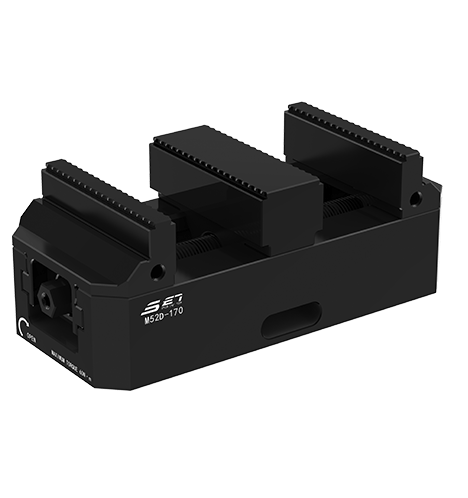 52mm Double Position Vise for Precision Batch MachiningThis manual vise offers two workstations with a compact jaw width, ensuring clear cutter paths for small precision parts processed in batches. It provides quick clamping with ±0.01mm repeatability.View Product →
When the machining forces are high and the fixture must remain extremely rigid, an octagonal taper zero-point locator is the better choice. The octagonal cross-section resists torque and side loads better than a round pin, making it suitable for large or asymmetrical parts.
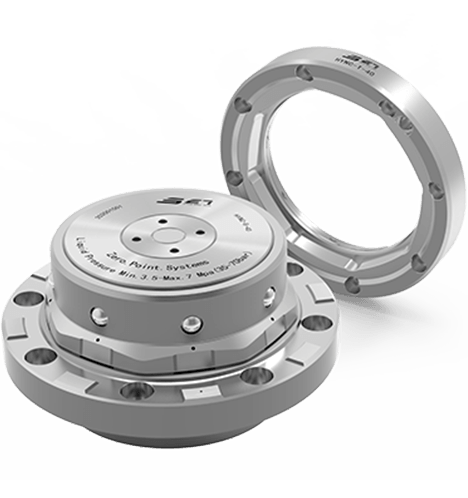 Octagonal Taper Zero-Point Locator for Rigid FixturingDesigned for high machining forces, this locator uses an octagonal cross-section to resist torque and side loads, making it ideal for large or asymmetrical parts while ensuring 0.003mm repeatability.View Product →
For more on how zero-point systems affect stability in five-axis machining, see how zero-point clamping improves workpiece stability in 5-axis CNC machining.
What to Check Before You Commit to a 5-Axis Workholding Setup
- Worktable and T-slot compatibility: Confirm that the zero-point base plate fits the table side and that the T-slot positions match the locator spacing.
- Stack height: Calculate the total stack height including the base plate, locator, pallet, and vise. A lower stack gives more cutting range.
- Clamping force: Match the puller force to the maximum cutting force that will be applied.
- Accessory availability: Check that locating pins, locking pullers, and protection plugs are available for the specific locator size you have chosen.
- Automation readiness: If you are planning robotic loading or a pallet system, choose a zero-point locator that can be released pneumatically.
- Future expansion: Buy a base plate that can accept multiple locator types, so you can extend the system later without replacing the entire table.
When evaluating systems, look for these attributes: Low stack height Taper locking Automation-ready 0.005 mm repeatability
Frequently Asked Questions
Q1: What is the difference between a zero-point locator and a conventional vise?
A zero-point locator is a module that automatically positions and locks a fixture or pallet against a base plate. A vise is a clamping device that secures the workpiece itself. In a five-axis cell, you often combine both.
Q2: Can I use a zero-point base plate on an existing five-axis machine?
Yes, in most cases. You mount the base plate directly on the machine table or on the tombstone, using the existing T-slots. The base plate must be matched to the table dimensions and to the machine's X and Y travel.
Q3: How much setup time can a zero-point system save in five-axis machining?
Compared with manual clamping, zero-point changeover reduces setup time from several minutes to roughly 30 seconds per changeover. For high-mix jobs, this can restore several hours of spindle time per shift.
Q4: Should I choose pneumatic or manual zero-point locators?
Manual locators are simpler and cheaper when the same fixture stays on the machine for a long time. Pneumatic locators are better when you automate, because the system can release and lock without an operator.
latest news

- Large Scale CNC Machining: How Workholding and Zero-Point Systems Maximize Output
- Air Gripper Selection Guide: Types, Grip Force, and Automation Integration
- CNC Pallet System Guide: How Zero-Point Pallet Quick Change Cuts Setup Time
- Pneumatic Workholding Solutions: How to Cut Your CNC Setup Time and Errors
Latest news
-
Air Gripper Selection Guide: Types, Grip Force, and Automation IntegrationA robot cell that runs five different part numbers in one shift is no longer unusual. The air gripper at the end of the arm picks and places, but when the product changes, the gripper often has to be...Read More
-
CNC Pallet System Guide: How Zero-Point Pallet Quick Change Cuts Setup TimeImagine a vertical machining center with the spindle stopped while the operator swaps a vise, indicates a fixture, and touches off three new tools. Fifteen minutes per changeover seems small until it...Read More
-
Pneumatic Workholding Solutions: How to Cut Your CNC Setup Time and ErrorsWorkholding is often the hidden time thief in a machining shop. A part that takes three minutes to clamp can turn a 30-second cycle into a 3-minute event, and across a shift that drains every hour of...Read More
-
Machine Tending Tools: How Quick-Change Grippers and Zero-Point Systems Cut CNC DowntimeA production manager watches the clock. The spindle stops, the operator walks over, waits for the table to unclamp, swaps a fixture, re-clamps, and starts the next part. That scene repeats several ti...Read More
-
Machine Tending Fixtures: Key Factors Behind a Stable CNC Machining CellThe night shift operator calls maintenance before the robot has run for an hour. The arm comes down to the same teach point every cycle, but the part is 0.03 mm off in the fixture. Within minutes the...Read More
Contact Details
- Address: 1-4 Floors, 17#03, Building 17, No. 269, Xinfeng Road, Xukou Town, Wuzhong District, Suzhou City
- Fax: +86-18112607008
- Tel: 18112607008
- Email: [email protected]
Mobile terminal
Copyright © SET Industrial | Zero-Point Positioning & CNC Workholding ALL RIGHTS RESERVED.