

 English
 русский
 Español
 简体中文
简体中文
Workholding is often the hidden time thief in a machining shop. A part that takes three minutes to clamp can turn a 30-second cycle into a 3-minute event, and across a shift that drains every hour of...
Read More
Pneumatic Workholding Solutions: How to Cut Your CNC Setup Time and Errors
Workholding is often the hidden time thief in a machining shop. A part that takes three minutes to clamp can turn a 30-second cycle into a 3-minute event, and across a shift that drains every hour of productive spindle time. Pneumatic workholding changes that math. By using compressed air to drive a locating and locking mechanism, a two- or three-second push of a button replaces a wrench, a hammer, or a staged sequence of manual clamps. The result is not just faster changeover, but more consistent clamping force, better repeatability, and a clear path to automated loading.
What Is Pneumatic Workholding?
Pneumatic workholding is a fixture or pallet system that uses compressed air as the actuation medium to clamp and locate a workpiece or a subassembly. In practice, the air pressure moves a piston inside a zero-point or clamping unit. That piston pulls a tapered or ball-lock insert into the body of the locator, locking the fixture against a hardened reference surface. When the air is released, a spring or return mechanism unlatches the insert and the fixture can be lifted away.
The classic form is the pneumatic zero-point locator. A base plate on the machine table contains one or more locators. Fixtures and pallets have matching pull studs or positioning inserts. With air pressure applied, the fixture is pulled down against the plate, creating a rigid connection that can withstand cutting forces. Because the locating surface is constant, the workpiece position repeats to the same registration point every time.
For several machining centers and automation cells, these pneumatic built-in zero-point locators deliver a compact solution that fits inside the base plate without occupying the top surface. The LQNC20 style, for example, is designed for direct mounting in a base plate and uses a straight-column ball-lock mechanism. This arrangement is common in applications where vertical space is at a premium and multiple locating points are needed.
Why Pneumatic Workholding Matters in CNC Machining
The simplest reason to choose a pneumatic workholding system is speed. Manual clamping with bolts and straps can easily consume two to five minutes per changeover. A pneumatic system does the same job in about two to three seconds. That reduction matters most on machines that run small batches and frequent changeovers. In a job shop, the time saved quickly becomes extra output.
Just as important is consistency. When an operator clamps a part by hand, the force varies from part to part and from person to person. Some setups are overtightened, some are too loose. Pneumatic clamping applies the same air pressure and the same mechanical travel every time. This consistent preload improves dimensional stability and reduces the chance of a workpiece shifting during rough cuts.
Safety also improves. An operator never reaches into the machining area to apply force. With a foot pedal or a PLC-controlled sequence, the clamp can be activated while the operator is clear. And because the system can be controlled by an M-code, the machine can verify that the fixture is locked before the spindle moves. That logic is already the foundation of many unattended machining cells.
Finally, pneumatic workholding supports light automation. When you can switch a pallet or fixture automatically, you can free an operator to run more than one machine. Combining pneumatic actuation with a five-axis zero-point quick change setup allows a single pallet system to feed a five-axis machining center through different orientations without re-clamping the workpiece manually.
How to Choose a Pneumatic Workholding System
Before you buy, look at the total system, not just the clamps. The key questions are: how much clamping force do you need, where will the locator mount, and how will you verify position in an automated cycle?
Clamping force is the starting point. The required force depends on the size of the cutting loads, the weight of the fixture, and the friction at the locating interface. In many milling applications, the force from a zero-point locator is far greater than the cutting force, but you still need to calculate the worst case. Compressed air alone can generate a high pull-in force through the piston area and the mechanical amplification of a ball-lock or taper.
Mounting style is not a minor detail. It affects how much space the fixture occupies, how easy it is to maintain, and how you install it. The table below compares three typical installation styles for pneumatic zero-point locators.
| Installation Style | Structural Feature | Typical Use |
|---|---|---|
| Flange-type | Mounts from the side of the unit, allowing access without removing the locator from the plate | Palletized machining and frequent fixture changes |
| Built-in type | Recessed into the base plate, preserving the top surface for other locating elements | Compact multi-station setups and limited vertical space |
| Table/threaded type | Directly threaded into the table or a custom subplate, providing high rigidity | Large workpieces and heavy cutting operations |
Repeatability is the next consideration. A well-made pneumatic zero-point locator can achieve a repeatability of 0.005 mm or better at the locating interface. For most machining, that is more than enough to maintain accurate part-to-part consistency. If you need verification, choose a locator with a sensor function. The same compressed air channel can trigger a switch that tells the control when the insert is fully locked. This is valuable in automatic pallet loading, where a missing lock can ruin a part or a machine.
Maintenance is easy to overlook. Pneumatic systems are simple: a filter, a regulator, and a few moving parts. But if the air is not clean and dry, moisture can enter the piston cavity and cause corrosion. Plan for a filter-regulator at each machine and check seals periodically. A good pneumatic workholding system will run for years with very little maintenance.
Integrating Pneumatic Workholding with Zero-Point Systems
Pneumatic workholding is most powerful when it is part of a zero-point system. The zero-point concept is simple: a common base plate on the machine table defines a fixed, repeatable position. All fixtures and pallets use the same locating interface. Instead of indicating each fixture every time, you drop the fixture onto the plate and lock it. Pneumatic actuation takes this one step further by making the lock status visible and controllable from the machine control.
For a retrofit or a new machine, the flange-type automatic zero-point locator is a practical choice. It can be mounted to the side of a base plate or a subplate, which keeps the top surface open for locating pins and part access. The flange-style body also makes it easy to add air lines and sensor connections without interfering with the fixture footprint.
The integration sequence is straightforward. You add zero-point locators to the machine table or a base plate. You prepare the fixture or pallet with matching pull studs and dowels. Then you wire the air line and (if used) the sensor to the machine PLC. When the PLC receives a start signal, it applies air pressure, locks the pallet, and confirms the position. Only then does the machining cycle begin. This sequence turns a manual changeover into a machine-controlled event.
Real-World Applications for Pneumatic Workholding
Pneumatic workholding is not limited to one type of machine. On a vertical machining center, a pneumatic zero-point base plate can hold multiple small fixtures for a run of parts. On a horizontal machining center, the same plate can be mounted to a tombstone, and the pallet can be changed from the front while the spindle keeps working. This is exactly the scenario that an automotive welding automation cell benefits from, where fast pallet or fixture changeover directly affects line uptime.
In large vertical lathes, the clamping area is often too large for manual fixtures to be changed frequently. Pneumatic zero-point systems with long-reach locators allow a fixture to be lifted off, cleaned, and replaced with a different diameter ring without loosening dozens of bolts. This saves hours of setup time on every changeover.
For clamping the workpiece itself, pneumatic vises provide the same quick-change logic. A pneumatic vise uses compressed air to drive the movable jaw, and depending on the model, it can be self-centering or single-acting. The jaw force is adjustable through the air regulator, so you can use the same vise for a thin-walled aluminum part in the morning and a steel forging in the afternoon. That flexibility is why pneumatic vises remain a staple in high-mix, low-volume production.
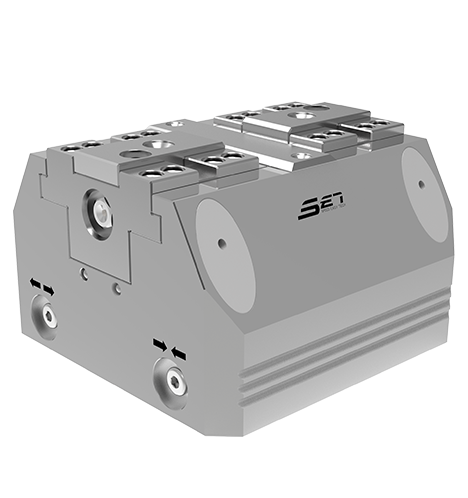 Adjustable Pneumatic Vise with Precision Repeatability for Flexible WorkholdingThis pneumatic vise offers adjustable clamping force through an air regulator, enabling quick changeovers between thin-walled aluminum and steel forgings. With 0.01mm repeatability and interchangeable jaws, it suits high-mix, low-volume machining.View Product →
Frequently Asked Questions
Q1: How much air pressure does a pneumatic workholding system need?
Most pneumatic workholding systems operate on standard shop air, typically 0.4 to 0.8 MPa (about 60 to 115 psi). The clamping force is created by the piston area plus the mechanical advantage of the lock mechanism. You can adjust the regulator to fine-tune the force, but you should check the manufacturer's maximum pressure rating before changing the setting.
Q2: Can pneumatic workholding hold heavy parts during milling?
Yes, if you select the correct size and number of locators. The total holding force is the sum of the forces from all engaged units. A heavy steel part on a five-axis machine might need four locators, while a light aluminum fixture might need only two. The important thing is to compare the actual cutting force vector against the clamping force and add a safety margin.
Q3: What is the repeatability of a pneumatic zero-point system?
For a quality system, the repeatability at the locating interface is typically in the range of 0.005 mm or better. That level of repeatability makes it possible to exchange fixtures without re-indicating them. If you are running a part that requires tighter control, use the same locator and base plate combination and verify the position with a dial gauge or a sensor.
Q4: Should I choose a manual or pneumatic quick-change system?
If you run small batches and high changeover frequency, pneumatic is usually the right choice. It reduces operator effort and enables automated control. If you have only occasional fixture changes and you are working with very heavy pallets, a manual system might be simpler and less expensive. A common strategy is to keep manual locating devices for large, slow-moving setups and add pneumatic zero-point locators for the fast-cycling fixtures.
Pneumatic workholding is not a single product; it is a way to think about changeover. Once a machine table has a repeatable zero-point interface and air-actuated clamps, you can move from fixture to fixture with minimal loss of time. The economic benefit appears in every short run, every night shift, and every automated cell where the spindle waits for the operator instead of the part. If you are planning a new machining cell or retrofitting an existing center, start by mapping the fixtures you use on a given machine. The right pneumatic workholding system will reduce setup time, improve repeatability, and make the move to unattended production much easier.
latest news
- Pneumatic Workholding Solutions: How to Cut Your CNC Setup Time and Errors
- Machine Tending Tools: How Quick-Change Grippers and Zero-Point Systems Cut CNC Downtime
- Machine Tending Fixtures: Key Factors Behind a Stable CNC Machining Cell
- 5-Axis Workholding: How Zero-Point Systems and Vises Maximize Machining Stability
Latest news
-
Machine Tending Tools: How Quick-Change Grippers and Zero-Point Systems Cut CNC DowntimeA production manager watches the clock. The spindle stops, the operator walks over, waits for the table to unclamp, swaps a fixture, re-clamps, and starts the next part. That scene repeats several ti...Read More
-
Machine Tending Fixtures: Key Factors Behind a Stable CNC Machining CellThe night shift operator calls maintenance before the robot has run for an hour. The arm comes down to the same teach point every cycle, but the part is 0.03 mm off in the fixture. Within minutes the...Read More
-
5-Axis Workholding: How Zero-Point Systems and Vises Maximize Machining StabilityA five-axis machining center is only as good as the workholding that supports it. A fixture that blocks the rotary table or interferes with the cutter path turns a five-axis machine into a three-axis...Read More
-
How Do Locating and Alignment Accessories Define CNC Machining Accuracy?Introduction: The Hidden Cost of Misalignment In CNC machining, the difference between a high-value precision component and a scrap part often comes down to a fraction of a millimeter. While spindles...Read More
-
What Clamping System Delivers the Best Accuracy and Throughput for Your Vertical Machining Centre?Why Clamping Systems Define VMC Performance In vertical machining centres, the clamping system is not a passive accessory—it is the structural link between the machine spindle and the workpiece. A ri...Read More
If you are interested in our products, please consult us
Contact Details
- Address: 1-4 Floors, 17#03, Building 17, No. 269, Xinfeng Road, Xukou Town, Wuzhong District, Suzhou City
- Fax: +86-18112607008
- Tel: 18112607008
- Email: [email protected]
Products
Quick Link
News Center
Mobile terminal
Copyright © SET Industrial | Zero-Point Positioning & CNC Workholding ALL RIGHTS RESERVED.