

 English
 русский
 Español
 简体中文
简体中文
The Real Bottleneck on Horizontal Machining Centers
A horizontal machining center (HMC) can run continuously through faces of a part, but the hours lost between jobs are what often hurt the productio...
Read More
How Quick Change Tool Shanks and Octagonal Taper Zero Point Locators Cut CNC Lathe Setup Time
Where Changeover Time Actually Disappears on a Lathe
Most shops track cycle time obsessively, yet the biggest hidden cost on a CNC lathe rarely happens during cutting. It happens between jobs, when a turret has to be re-tooled, an operator re-touches every offset, and a machine sits idle while paperwork says it is "in production." On small-batch and high-mix work, changeover can consume more spindle hours over a month than actual chip-making.
The physical source of that delay is almost always the same: tooling that is bolted, shimmed, or clamped directly to the turret or tailstock, with no repeatable reference surface. Every removal forces a full re-measurement. Two hardware categories exist specifically to remove that step: modular tool shanks that separate the cutting head from the mounting interface, and tapered locating systems that let an entire fixture or tool block be pulled off and reinstalled within a few microns of its previous position.
Setup time Repeatability Bar feeder uptime Multi-spindle changeover
Quick Change Tool Shank Series: Separating the Head from the Holder
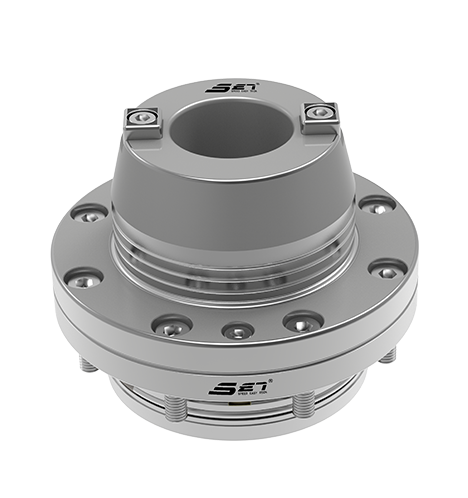
The core idea behind a quick change tool shank series is straightforward: the cutting insert lives in a small head unit, and that head unit locates into a fixed base shank through a matched dovetail or serrated coupling, secured with a single clamping screw or lever. The base shank never leaves the turret pocket. Only the head assembly moves.
This matters for three practical reasons. First, tool height and centerline offsets are set once in the base shank and hold across every head swap, because the coupling geometry repeats to a tight tolerance rather than depending on how tightly an operator torques a mounting bolt. Second, an insert change no longer requires pulling the whole holder out of the turret, so there is nothing to re-clock or re-square. Third, wear items and specialty geometries can be pre-set on a bench, off the machine, while the lathe keeps running a different job.
Typical Coupling Specifications
| Shank Format | Coupling Type | Repeatability | Typical Use Case |
|---|---|---|---|
| Square shank, 16 to 32 mm | Serrated face coupling | Within 0.005 mm | General turning, small to mid lathes |
| Round shank, boring bar style | Dovetail slide with locking cam | Within 0.003 mm | Internal boring, deep bore work |
| Block-mount, VDI compatible | Curvic-style radial coupling | Within 0.005 mm | Turret-based turning centers |
Because the coupling geometry is self-locating, operators typically report that a head swap plus verification cut takes under two minutes, compared with ten to fifteen minutes for a conventional bolt-on holder that needs a dial indicator check afterward.
Octagonal Taper Zero Point Locator: How the Geometry Holds Position
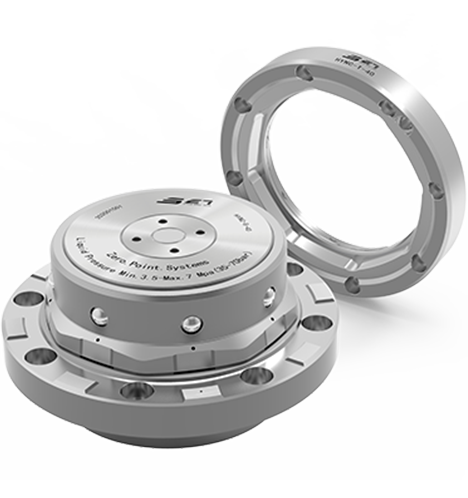
Where a quick change shank solves the tool-head problem, an octagonal taper zero point locator solves the fixture and tool-block problem. Instead of a round taper, the locating pin uses an eight-sided taper profile that seats into a matching eight-sided socket. The extra flat faces do two jobs at once: they carry radial load without relying on a single line of contact, and they lock rotational orientation so the fixture always lands in the same clocked position, not just the same X-Y-Z location.
A pull stud or drawbar mechanism beneath the socket pulls the taper down and inward as it engages, seating the octagonal faces fully before locking. Because the mechanism is spring or hydraulic actuated rather than torque-dependent, clamping force is consistent every cycle, which is the real reason repeatability holds up over thousands of load and unload cycles rather than degrading after the first few hundred.
Engagement Sequence
Rotational locking through a multi-face taper is what allows a fixture to be swapped and reloaded without a follow-up dial-indicator check, which is the step that normally eats the most setup time on a lathe.
Zero Point Locator Accessories: Building a Complete Clamping Station
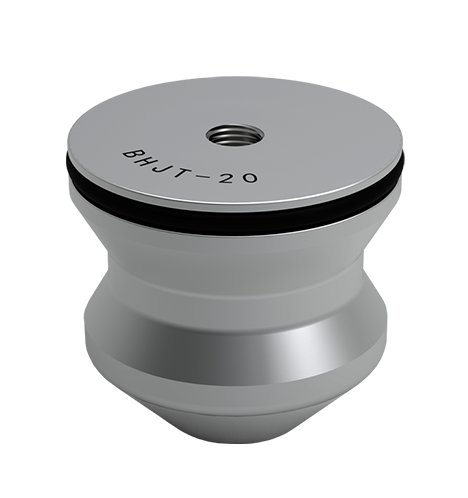
A single locator socket rarely works alone. Most shops build out a clamping station using a family of zero point locator accessories so that pallets, vises, soft jaws, and sub-plates can all reference the same zero point regardless of which fixture is loaded that day.
Common Accessory Categories
- Base sockets for machine tables, sub-plates, and tombstones
- Pull studs sized to match specific fixture thicknesses
- Manual, pneumatic, and hydraulic actuation blocks
- Riser plates that raise a fixture above chip and coolant buildup
- Cleaning tools for clearing chips from the taper socket before reload
- Position sensors that confirm full seating before a cycle start signal is released
The sensor category deserves particular attention on unattended or lightly attended shifts. A socket that looks seated but has a chip trapped under one flat face can shift a fixture by a small but real amount, enough to scrap a precision bore. A seating confirmation sensor interrupts the cycle start rather than letting the machine run on a false-positive clamp.
Fitting These Systems Into an Existing Lathe Cell
Retrofitting modular tooling onto a machine that already has a defined tool list is less disruptive than it sounds, because both shank and locator systems are designed to sit inside interfaces the machine already uses. A quick change shank series typically comes in VDI and square-block footprints, so it drops into existing turret pockets without machine modification. Zero point sockets bolt to an existing sub-plate or table in the same bolt pattern the fixture already used.
Where Compatibility Questions Usually Come Up
| Machine Feature | Compatibility Consideration |
|---|---|
| Bar feeder equipped lathe | Locator sockets on the sub-spindle side must clear the feed tube travel path |
| HSK spindle tooling | Shank couplings are independent of the spindle taper, so both can be used together |
| Compact turning centers such as a Haas ST series lathe | Low-profile VDI shank heads reduce turret clearance conflicts on smaller envelopes |
| Sub-spindle transfer operations | Zero point sockets on both spindles keep part orientation consistent after transfer |
On bar feeder lines specifically, the value compounds. A feeder already removes manual bar loading from the cycle; pairing it with quick change tooling removes the second major source of idle time, which is re-tooling between bar diameters or part families. The combined effect is fewer full stops per shift rather than a large change to any single cycle time.
Choosing Between Shank-Level and Fixture-Level Modularity
Not every job needs both systems at once. A useful way to decide is to look at what changes most often on the floor: the cutting tool itself, or the whole workholding setup.
Choose Shank Series When
- Insert and tool geometry changes frequently within the same part family
- Boring bar reach or diameter varies job to job
- Turret pocket count is limited and tool density needs to increase
Choose Zero Point Locators When
- Fixtures, vises, or soft jaws are swapped between unrelated part numbers
- Multiple machines need to share the same fixture inventory
- First-article inspection time needs to shrink after a fixture reload
Many high-mix shops eventually adopt both, since the two systems address different stages of the same changeover: shanks shorten tool-level swaps, locators shorten fixture-level swaps, and together they reduce the number of manual alignment checks an operator has to perform per shift.
Keeping Repeatability Over the Life of the Tooling
Repeatability is a mechanical claim, and like any mechanical claim it degrades if the interface is abused or contaminated. A few habits preserve the tolerances these systems are built to hold.
- Clear chips and coolant residue from taper faces and coupling serrations before every reload, not just at shift change
- Inspect pull studs and clamping screws for wear on a fixed schedule rather than only after a problem appears
- Avoid dragging a fixture across a socket face during placement, since a scored face changes contact geometry permanently
- Log seating force or sensor confirmation data where the control allows it, so a slow drift in clamping force is caught before it causes a part failure
Shops that treat these interfaces as consumable-adjacent, meaning they get the same routine attention as an insert or a coolant filter, tend to keep repeatability numbers close to the original specification for years rather than months.
Frequently Asked Questions
Q1: Does adding modular tooling require reprogramming existing CNC lathe programs
Generally no. Tool length and offset values are set once against the new base shank or fixture zero point, and the program continues to call the same tool number or work offset it already used. The physical interface changes, not the program logic.
Q2: How much clamping force does an octagonal taper locator need to hold position under turning loads
Clamping force is sized to the fixture weight, part mass, and expected cutting forces rather than a single fixed number, which is why manual, pneumatic, and hydraulic actuation options exist across the accessory range. A supplier or tooling engineer typically sizes this based on the heaviest fixture and most aggressive roughing pass expected on that station.
Q3: Can quick change tool shanks and zero point locators be used on the same lathe at the same time
Yes. They address different interfaces on the machine, the turret side for shanks and the table or sub-plate side for locators, so there is no mechanical conflict between running both systems simultaneously.
Q4: Is retrofitting these systems disruptive to a lathe that is already in production
Installation is usually limited to bolting a base shank into an existing pocket or a socket onto an existing sub-plate, both within the machine's original mounting pattern. Downtime is closer to a normal tooling changeover than a machine rebuild.
Q5: What is the main sign that a zero point locator needs maintenance
A gradual increase in first-part variation after a fixture reload, even when the program and offsets have not changed, is the most common early sign, and usually traces back to chip contamination or wear on the taper faces rather than a control or programming issue.
latest news

- Horizontal Machining Centers: Cut Setup Time with Zero-Point Workholding
- Large Scale CNC Machining: How Workholding and Zero-Point Systems Maximize Output
- Air Gripper Selection Guide: Types, Grip Force, and Automation Integration
- CNC Pallet System Guide: How Zero-Point Pallet Quick Change Cuts Setup Time
Latest news
-
Large Scale CNC Machining: How Workholding and Zero-Point Systems Maximize OutputPicture a 1.4 m cast-iron housing sitting beside a horizontal machining center. The spindle can remove metal quickly, but the real bottleneck is everything before the first chip: lifting the blank, l...Read More
-
Air Gripper Selection Guide: Types, Grip Force, and Automation IntegrationA robot cell that runs five different part numbers in one shift is no longer unusual. The air gripper at the end of the arm picks and places, but when the product changes, the gripper often has to be...Read More
-
CNC Pallet System Guide: How Zero-Point Pallet Quick Change Cuts Setup TimeImagine a vertical machining center with the spindle stopped while the operator swaps a vise, indicates a fixture, and touches off three new tools. Fifteen minutes per changeover seems small until it...Read More
-
Pneumatic Workholding Solutions: How to Cut Your CNC Setup Time and ErrorsWorkholding is often the hidden time thief in a machining shop. A part that takes three minutes to clamp can turn a 30-second cycle into a 3-minute event, and across a shift that drains every hour of...Read More
-
Machine Tending Tools: How Quick-Change Grippers and Zero-Point Systems Cut CNC DowntimeA production manager watches the clock. The spindle stops, the operator walks over, waits for the table to unclamp, swaps a fixture, re-clamps, and starts the next part. That scene repeats several ti...Read More
Contact Details
- Address: 1-4 Floors, 17#03, Building 17, No. 269, Xinfeng Road, Xukou Town, Wuzhong District, Suzhou City
- Fax: +86-18112607008
- Tel: 18112607008
- Email: [email protected]
Mobile terminal
Copyright © SET Industrial | Zero-Point Positioning & CNC Workholding ALL RIGHTS RESERVED.