

 English
 русский
 Español
 简体中文
简体中文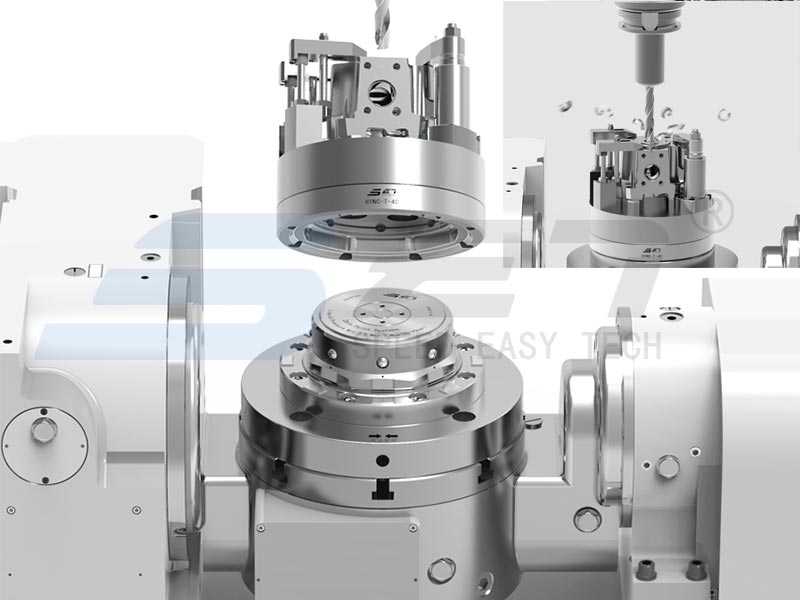
Workholding is often the hidden time thief in a machining shop. A part that takes three minutes to clamp can turn a 30-second cycle into a 3-minute event, and across a shift that drains every hour of...
Read More
Octagonal Taper Zero Point Clamping System | CNC Lathe Flexible Machining Upgrade & Domestic Workholding Solution
Introduction
High-mix and small-batch mixed production has become the mainstream operation mode in modern machining industries. CNC horizontal lathes and turn-mill centers commonly face typical workflow limitations, including tedious fixture changeover, time-consuming manual alignment, unstable clamping precision, inconsistent benchmark references across working procedures, and low compatibility with automated production lines.
Traditional chuck clamping solutions require 20 to 40 minutes for a single fixture replacement, resulting in insufficient machine runtime efficiency. Thin-walled and precision workpieces often suffer from clamping deformation and poor dimensional consistency, restricting stable automated mass production and unattended lights-out machining.
To solve these common industrial bottlenecks, SET independently developed a dedicated octagonal taper zero point clamping system for horizontal lathe processing. Featuring dual-sided octagonal constraint positioning, universal modular interfaces, intelligent detection and automatic cleaning functions, as well as high-strength heavy-load structures, the system provides standardized, high-precision and quick-change flexible workholding solutions. It serves as a reliable domestic alternative to imported high-end fixtures, widely applicable for automotive, aerospace, precision machinery and other high-standard machining scenarios.
1. Core Limitations of Traditional Horizontal Lathe Clamping
Conventional manual, hydraulic and pneumatic split fixtures lack unified benchmark standards and quick-change structures, leading to weak adaptability for flexible mixed production. Five typical processing challenges are summarized as follows:
Low changeover efficiency and insufficient machine utilization
Traditional fixture replacement involves repeated disassembly, manual dial indicator alignment and tool resetting. Each changeover process takes 20 to 40 minutes, occupying effective cutting time during frequent model switching. Most machining workshops maintain machine utilization rates below 60% under conventional clamping modes.
High manual dependence and unstable batch precision
Clamping and positioning quality relies heavily on manual calibration, which inevitably produces human errors. Thin-walled shaft parts and precision disk components are prone to clamping deformation, resulting in scattered batch dimensions and relatively high defective rates.
Reference offset and accumulated errors across procedures
Workpieces require repeated clamping and positioning during multi-station transfer. Continuous benchmark deviation causes superposed processing errors, failing to meet precision requirements for continuous high-precision machining.
Non-universal interfaces restricting automated upgrading
Traditional fixtures adopt non-standard docking structures without integrated cleaning and seating detection functions, making it difficult to match robotic loading and unloading systems and blocking the realization of unattended intelligent production.
Insufficient clamping rigidity for heavy-load machining
Conventional fixtures feature simple constraint structures with limited shear resistance. Workpieces are prone to vibration and slight displacement during heavy stock removal, reducing overall machining stability.
2. System Structure & Working Principle
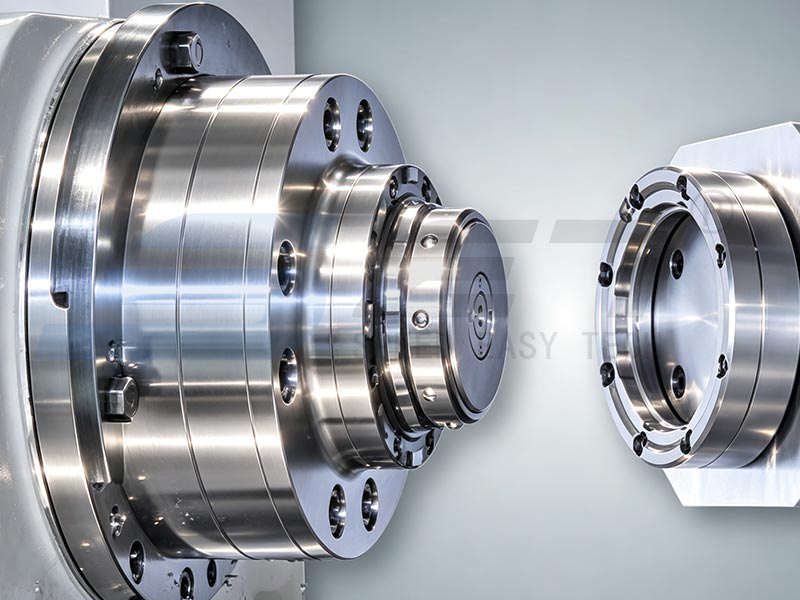
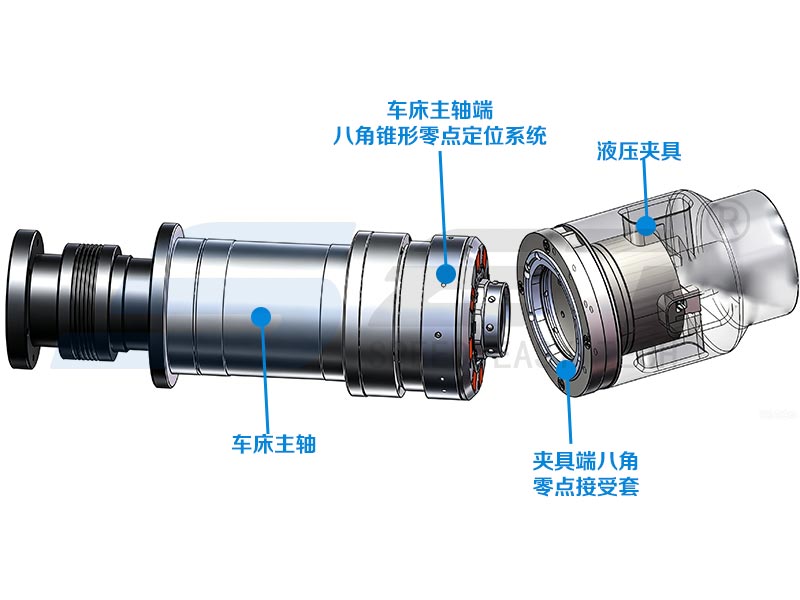
Customized for 8–10 inch horizontal lathe chucks, the SET octagonal taper zero point clamping system consists of a spindle-end clamping actuator and a fixture-end receiving sleeve, compatible with hydraulic, manual and pneumatic standard chuck fixtures.
The clamping actuator is fixed on the machine spindle, while the receiving sleeve is integrated on the fixture end face. Driven by the lathe spindle drawbar, the system realizes automatic fixture opening, closing and precise clamping without manual adjustment, supporting rapid interchange of various fixture types.
The core unit adopts an octagonal taper self-centering dual-sided constraint structure. Multi-surface fitting limiting design improves shear resistance and greatly enhances positioning rigidity and operational stability. By optimizing pull stud diameter and piston force transmission structure, internal locking steel balls output uniform and stable clamping force to ensure high-precision and rigid positioning performance.
Equipped with through-hole indexed pull studs, the system supports installation of long and ultra-high workpieces embedded inside the chuck. It effectively solves unstable clamping problems for special-shaped components and adapts to large-travel and high-rigidity machining demands.
3. Core Technical Advantages
3.1 Micron-level Positioning Accuracy with Superior Rigidity & Stability
Combining octagonal taper self-centering and multi-point steel ball locking dual constraints, the system delivers stable repeat positioning accuracy within 0.005mm, eliminating manual alignment errors and accumulated deviation from repeated clamping procedures.
The dual-sided constraint structure provides strong shear resistance, maintaining stable clamping status without vibration or displacement during heavy cutting. It fully adapts to high-precision and high-load processing scenarios, including aerospace thin-wall parts, precision shaft components and heavy forgings.
3.2 Universal Standard Interface for Minute-level Quick Change
The unified universal fixture interface is compatible with full-series horizontal lathe chuck fixtures. No machine tool modification is required for rapid fixture switching. The system supports offline presetting, requiring only simple docking and locking on machine tools.
Single fixture changeover time is shortened to 1–3 minutes, effectively reducing machine idle time and significantly improving production flexibility for multi-variety mixed batch manufacturing.
3.3 Intelligent Detection & Air-blow Cleaning for Unmanned Production
Built-in air tightness detection sensors monitor fixture fitting and locking status in real time, effectively avoiding incomplete clamping and loose clamping risks. The integrated air-blow cleaning structure automatically removes iron chips and dust from positioning surfaces, preventing precision deviation caused by residual contaminants.
The system supports 24-hour continuous unattended machining and seamless docking with automated loading and unloading equipment, laying a solid foundation for intelligent lights-out workshops.
3.4 Reinforced Heavy-duty Structure for Long-term High-intensity Production
Optimized specifically for heavy metal cutting environments, core force-bearing components are structurally upgraded with enhanced impact resistance and fatigue resistance. The system supports millions of stable locking cycles, maintaining stable structural performance and consistent precision during long-term high-load continuous production.
3.5 Unified Benchmark System for Cross-process Flexible Transfer
The system integrates machining, calibration and inspection benchmarks into a unified standard. Workpieces can circulate across different equipment and working procedures without repeated positioning, eliminating accumulated processing errors.
It effectively controls thin-wall workpiece clamping deformation and ensures consistent batch dimensional accuracy, breaking isolated single-process production barriers and adapting to flexible assembly line production layouts.
4. Quantifiable On-site Application Benefits
Practical workshop application data verifies comprehensive production optimization after adopting the SET octagonal taper zero point clamping system:
Improved changeover efficiency and machine utilization
Manual alignment and tool setting procedures are eliminated, reducing non-cutting auxiliary time by over 90%. The average machine utilization rate rises above 85%, with overall workshop production capacity increased by 30% to 55%.
Stable machining precision and reduced defective rate
Micron-level repeat positioning avoids manual errors and optimizes clamping deformation control. Batch workpiece dimensional consistency is greatly improved, reducing workshop defective rates by more than 50%.
Automation compatibility supports lights-out manufacturing
Standardized interfaces match robotic arms and AGV automatic handling systems, realizing full-process automation of fixture switching, workpiece clamping and continuous machining. Manual labor investment is reduced by over 40%, supporting stable 24-hour unattended turning production.
Cost-effective domestic alternative optimizes long-term production expenditure
The system serves as a practical substitute for high-end imported fixtures, featuring lower procurement cost, shorter delivery cycle and convenient after-sales maintenance. Modular components deliver long service life, effectively reducing average operational costs and shortening project return cycles.
5. Full-scenario Application Compatibility
Compatible Equipment
Suitable for 8–10 inch chuck CNC horizontal lathes, 4-axis horizontal turning machines, turn-mill composite centers and heavy-duty horizontal lathes. It supports pre-installation on new equipment and technical retrofitting of old machine tools without extensive bed modification.
Compatible Workpieces & Production Modes
Applicable to various precision rotary parts, including shaft components, disk parts, aerospace thin-wall structural parts, gearbox housings and motor spindles. It covers custom single-piece processing, small and medium mixed batch production, and standardized mass manufacturing scenarios.
6. Conclusion & Industry Outlook
The core of horizontal lathe flexible manufacturing upgrading lies in standardized and precise reconstruction of workpiece clamping benchmarks. The SET octagonal taper zero point clamping system solves typical industrial pain points including slow changeover, unstable precision, insufficient clamping rigidity and poor automation adaptability through four core advantages: octagonal dual-sided constraint positioning, universal quick-change interface, intelligent adaptive functions and heavy-load high-rigidity structure, achieving reliable domestic substitution for high-end imported fixtures.
Against the industrial trend of multi-variety and short-delivery manufacturing, standardized zero-point quick-change fixtures have become essential supporting equipment for modern horizontal lathe production lines. The solution helps machining enterprises respond flexibly to fluctuating order demands, improve workshop automation and digitalization levels, and build stable long-term competitive advantages in precision intelligent manufacturing.
Enterprises with lathe fixture upgrading demands can consult the SET technical team for customized zero point workholding solutions matched with specific equipment models, workpiece specifications and production modes.
latest news
- Pneumatic Workholding Solutions: How to Cut Your CNC Setup Time and Errors
- Machine Tending Tools: How Quick-Change Grippers and Zero-Point Systems Cut CNC Downtime
- Machine Tending Fixtures: Key Factors Behind a Stable CNC Machining Cell
- 5-Axis Workholding: How Zero-Point Systems and Vises Maximize Machining Stability
Latest news
-
Machine Tending Tools: How Quick-Change Grippers and Zero-Point Systems Cut CNC DowntimeA production manager watches the clock. The spindle stops, the operator walks over, waits for the table to unclamp, swaps a fixture, re-clamps, and starts the next part. That scene repeats several ti...Read More
-
Machine Tending Fixtures: Key Factors Behind a Stable CNC Machining CellThe night shift operator calls maintenance before the robot has run for an hour. The arm comes down to the same teach point every cycle, but the part is 0.03 mm off in the fixture. Within minutes the...Read More
-
5-Axis Workholding: How Zero-Point Systems and Vises Maximize Machining StabilityA five-axis machining center is only as good as the workholding that supports it. A fixture that blocks the rotary table or interferes with the cutter path turns a five-axis machine into a three-axis...Read More
-
How Do Locating and Alignment Accessories Define CNC Machining Accuracy?Introduction: The Hidden Cost of Misalignment In CNC machining, the difference between a high-value precision component and a scrap part often comes down to a fraction of a millimeter. While spindles...Read More
-
What Clamping System Delivers the Best Accuracy and Throughput for Your Vertical Machining Centre?Why Clamping Systems Define VMC Performance In vertical machining centres, the clamping system is not a passive accessory—it is the structural link between the machine spindle and the workpiece. A ri...Read More
If you are interested in our products, please consult us
Contact Details
- Address: 1-4 Floors, 17#03, Building 17, No. 269, Xinfeng Road, Xukou Town, Wuzhong District, Suzhou City
- Fax: +86-18112607008
- Tel: 18112607008
- Email: [email protected]
Products
Quick Link
News Center
Mobile terminal
Copyright © SET Industrial | Zero-Point Positioning & CNC Workholding ALL RIGHTS RESERVED.