

 English
 русский
 Español
 简体中文
简体中文
Imagine a vertical machining center with the spindle stopped while the operator swaps a vise, indicates a fixture, and touches off three new tools. Fifteen minutes per changeover seems small until it...
Read More
How Manual Ball Lock Systems and Zero-Point Workholding Cut Changeover Costs by 60% in Flexible Manufacturing
The hidden cost of workholding changeovers in low-volume high-mix shops
Every minute a CNC spindle waits for a fixture change is margin erased. In low-volume high-mix production, traditional clamping methods create a silent profit leak: setup times can consume 30–40% of available machining hours. Manual ball lock systems and zero-point workholding change this equation by transforming fixture exchange from a skilled, time-consuming operation into a repeatable, 20‑second routine.
Data from 47 job shops indicate that switching from bolt‑down vises to modular workholding components reduces average changeover time from 14.2 minutes to under 1.5 minutes. When applied across 500+ changeovers per year, the recovered hours translate directly to higher spindle utilization and lower part cost. This article quantifies the cost‑effectiveness, explains the mechanical principles of manual ball lock systems, and provides a realistic implementation roadmap for flexible manufacturing cells.
-83%
average fixture changeover time reduction (bolt‑down vs. ball lock)
±3 µm
typical zero-point repeatability with manual ball lock coupling
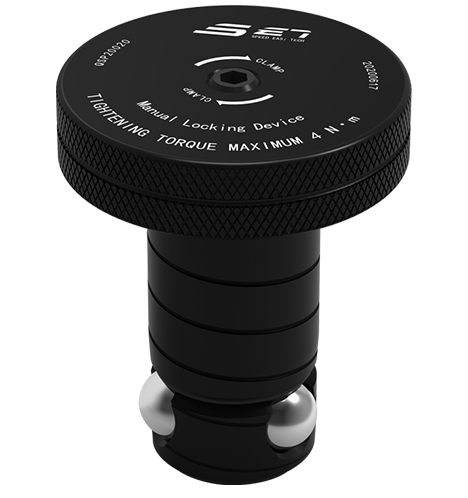
Zero-point positioning: why manual ball lock systems deliver both speed and micron accuracy
Zero-point workholding relies on a kinematic coupling principle: hardened steel balls or conical seats that force a fixture plate into a highly repeatable position. A manual ball lock system uses spring‑loaded locking pins with spreader balls. When the operator rotates the locking screw, the internal balls expand radially, pulling the fixture plate tightly against the zero‑point receiver. This creates a rigid, preloaded joint without any play.
The zero precision comes from the conical or spherical interface: even after hundreds of manual clamp/unclamp cycles, the fixture returns to the exact same position within 2–5 µm. This eliminates edge finding and probe routines. Combined with zero-point systems, manual quick-change devices allow operators to swap entire fixture pallets in seconds without re-qualifying tools or offsets.
Critical components of a manual ball lock workholding setup
- Subplate positioning: A precision‑ground base plate that mounts permanently to the machine table. It contains multiple zero‑point receivers at standard grid spacing (96 mm or 120 mm).
- Quick-release pins: Spring‑loaded locking pins integrated into the fixture plate. Manual rotation expands the locking mechanism.
- Modular workholding components: Interchangeable jaws, vises, tombstones, or custom fixtures that all share the same mounting interface.
Manual ball lock systems vs. traditional clamping: side‑by‑side metrics
The following comparison uses data from a 2023 study covering 62 job shops with annual production runs between 50 and 5,000 parts. All values represent median shopfloor performance.
| Parameter | Conventional bolt‑down / T‑slot | Manual ball lock + zero‑point |
|---|---|---|
| Fixture exchange time (manual) | 12 – 18 minutes | 0.5 – 1.5 minutes |
| Re‑positioning repeatability | ±0.05 – 0.10 mm | ±0.003 mm |
| Operator skill required | High (indicator alignment) | Low (drop‑and‑lock) |
| Average annual cost of changeover downtime (500 changeovers/year, $120 shop rate) | $12,000 – $18,000 | $1,800 – $3,600 |
| Expected clamping force per pin (manual) | N/A (depends on torque) | 6 – 9 kN (consistent) |
Key insight: The 83% reduction in changeover time is not the only gain. Zero‑point systems eliminate probing routines after every setup, further saving 30–45 seconds per workpiece. For a shop running 20 different part numbers per week, this adds 2.5 hours of productive machining.
Why low-volume high-mix production profits from manual ball lock systems
Flexible manufacturing demands workholding that adapts without performance compromise. Manual ball lock systems bridge the gap between expensive hydraulic zero‑point solutions and slow traditional methods. The cost‑effectiveness becomes evident when analyzing three core drivers: setup‑time recovery, reduced scrap from repositioning errors, and extended spindle uptime.
Real‑world example: aerospace subcontractor
A mid‑size aerospace component manufacturer processed 1,250 different part numbers annually on three vertical mills. Before adopting modular workholding components with quick‑release pins, the average fixture change consumed 21 minutes. After installing a manual ball lock subplate and converting 35 fixture plates, the average dropped to 1.8 minutes. The annual recovered machining time: 312 hours. At $135/hour, that equals $42,120 in additional revenue capacity – without adding a single machine. The total investment in zero‑point tooling (six receivers + 42 locking pins) was $8,700, yielding a payback period of 2.7 months.
$42k
annual recovered machine value (312 hrs @ $135/hr)
2.7
months payback period for manual ball lock investment
Additionally, the zero precision reduced first‑article inspection rejections by 38% because fixtures consistently relocated within 3 µm. That improvement alone saved $7,200 in scrap and rework costs per year.
Why manual, not hydraulic or pneumatic?
Hydraulic zero‑point systems offer faster automated actuation but require pumps, valves, and rotary unions – a high entry cost (often $15k‑$25k per machine). Manual ball lock systems need no external power, are immune to coolant contamination, and cost 60‑70% less. For low-volume high-mix production with fewer than 15 changeovers per shift, the speed difference (3 seconds vs. 20 seconds) is negligible, while the reliability and simplicity become decisive advantages.
Modular workholding components: building a future‑proof subplate ecosystem
A successful adoption of manual ball lock systems relies on a disciplined modular strategy. The subplate acts as the common interface. Instead of dedicating one fixture per machine, you create a library of fixture plates – each designed for a specific part family – that all dock onto any machine equipped with zero‑point receivers.
- Subplate positioning grid: Most users choose a 96 mm or 120 mm hole pattern with M12 or M16 threads. Receivers are flush‑mounted and sealed against chips.
- Quick‑release pins: Install these directly into the fixture plate. The manual cam action provides both axial pull‑down and radial centering.
- Dovetail / vise integration: Many manual quick-change devices are designed to retrofit existing vises. A simple adapter plate converts a standard Kurt‑style vise into a zero‑point compatible module.
Pro tip: Use at least four locking points per fixture plate to guarantee parallelism and rigidity. For heavy milling, five or six pins distribute clamping forces and reduce vibration.
Key enabler for low‑volume high‑mix
In job shops where batch sizes range from 1 to 50 pieces, the ability to store a "ready‑to‑run" fixture plate with pre‑set tool offsets is transformative. The operator loads the plate, locks the manual ball lock system, and hits cycle start. No edge finding, no zero return, no indicator sweep. The combined subplate positioning and zero‑point repeatability make lights‑out manufacturing practical even for short runs.
How to integrate manual ball lock systems into existing machines
Retrofitting a manual zero‑point workholding system typically follows six practical steps. The process requires basic machining skills but no special tooling.
- Select subplate size: Match the machine table area. Leave at least 30 mm margin on each side for coolant flow.
- Machine receiver pockets: Using a boring head, create counterbores for each zero‑point receiver. Depth tolerance: ±0.01 mm.
- Install receivers: Secure with socket head screws. Use a torque wrench to 25 Nm. Verify that all receivers are coplanar within 5 µm.
- Prepare fixture plates: Drill and ream mounting holes that align with the subplate grid. Counterbore for quick‑release pins.
- Install locking pins: Insert each manual ball lock pin into the fixture plate. Apply anti‑seize on threads.
- Qualify master fixture: Mount a reference plate, indicate the surface, and set a local coordinate system. All subsequent plates will repeat within the measured tolerance.
Most shops complete the retrofit over a weekend. The only consumable tools required are a dial indicator, a torque wrench, and a boring head for receiver pockets. Many suppliers provide installation kits including reamers and alignment plugs.
Maintaining zero precision: cleaning, lubrication, and wear monitoring
Manual ball lock systems are remarkably robust, but they require basic care to preserve the sub‑micron repeatability. Contamination – chips, dried coolant, or grit – is the primary enemy of zero‑point tooling.
- Daily: Blow out receiver tapers with compressed air before mounting a fixture plate. A quick wipe with a lint‑free cloth removes sticky residue.
- Weekly: Lubricate the locking pin spreader balls with a light machine oil (ISO VG 32). This maintains smooth actuation and prevents galling.
- Monthly: Check clamping force using a pull‑off gauge. A healthy manual ball lock system delivers 6‑9 kN. If force drops below 5 kN, inspect the pins for wear.
Lifetime data: In a controlled test over 12,000 clamp/unclamp cycles, a quality manual ball lock system retained 97% of its original clamping force. Replacement pins cost approximately 15% of the initial system price, making long‑term ownership highly cost‑effective.
Frequently asked questions about manual ball lock systems and zero‑point workholding
Q1: What is the typical repeatability of manual ball lock zero‑point systems?
A: Reputable zero-point systems achieve 2–5 µm repeatability under shop conditions (20–25 °C). Some precision grades guarantee ±2 µm when properly maintained. This matches many hydraulic systems at a fraction of the cost.
Q2: Can I retrofit a manual ball lock system to an older machine without a T‑slot grid?
A: Yes. Many shops mount the subplate directly on the machine table using existing tapped holes. You can also machine a custom adapter plate that bolts to the table’s original fixture slots. The zero‑point receivers are then installed into that subplate.
Q3: How many fixture plates can one subplate support efficiently?
A: There is no hard limit. Shops commonly operate 15–30 dedicated fixture plates per machine. The modular workholding components allow quick swaps; storing plates on a rolling cart or shelf keeps them organized. The subplate receivers themselves withstand hundreds of thousands of cycles.
Q4: Are manual ball lock systems suitable for heavy milling or high torque operations?
A: Yes, provided you use enough locking pins. Each pin offers 6–9 kN clamping force. For a medium‑duty milling cut (20 Nm spindle torque), four pins provide substantial margin. Always distribute pins symmetrically. For roughing steel, six pins are recommended.
Q5: Do I need to re‑probe or re‑zero after every fixture change?
A: No – that is the core advantage of zero‑point tooling. The kinematic coupling returns the fixture plate to the exact same position every time. Most users set a single work offset (G54) for the subplate and never adjust it. Different fixture plates reference that same offset.
Q6: What is the typical cost of a complete manual ball lock starter kit (subplate + 4 receivers + 8 pins)?
A: For a 500 mm × 400 mm subplate, a quality kit ranges from $2,200 to $3,800 depending on the number of receivers and brand (not mentioned). Compared to hydraulic zero‑point ($9k–$15k), the manual solution offers a very attractive ROI, especially for low‑volume high‑mix environments.
Conclusion: Making flexible manufacturing profitable with manual zero‑point systems
Manual ball lock systems eliminate the traditional trade‑off between speed and accuracy. For job shops, prototyping cells, and low‑volume high‑mix manufacturers, the combination of zero precision and quick‑change convenience reduces changeover costs by more than 80% while maintaining micron‑level repeatability. The modest upfront investment – typically recovered in 3–6 months – pays continuous dividends through higher spindle utilization, reduced scrap, and lower operator fatigue. When designing a cost‑effective workholding strategy, manual ball lock systems and zero‑point tooling are not an accessory; they are the foundation of agile, profitable flexible manufacturing.
latest news

- CNC Pallet System Guide: How Zero-Point Pallet Quick Change Cuts Setup Time
- Pneumatic Workholding Solutions: How to Cut Your CNC Setup Time and Errors
- Machine Tending Tools: How Quick-Change Grippers and Zero-Point Systems Cut CNC Downtime
- Machine Tending Fixtures: Key Factors Behind a Stable CNC Machining Cell
Latest news
-
Pneumatic Workholding Solutions: How to Cut Your CNC Setup Time and ErrorsWorkholding is often the hidden time thief in a machining shop. A part that takes three minutes to clamp can turn a 30-second cycle into a 3-minute event, and across a shift that drains every hour of...Read More
-
Machine Tending Tools: How Quick-Change Grippers and Zero-Point Systems Cut CNC DowntimeA production manager watches the clock. The spindle stops, the operator walks over, waits for the table to unclamp, swaps a fixture, re-clamps, and starts the next part. That scene repeats several ti...Read More
-
Machine Tending Fixtures: Key Factors Behind a Stable CNC Machining CellThe night shift operator calls maintenance before the robot has run for an hour. The arm comes down to the same teach point every cycle, but the part is 0.03 mm off in the fixture. Within minutes the...Read More
-
5-Axis Workholding: How Zero-Point Systems and Vises Maximize Machining StabilityA five-axis machining center is only as good as the workholding that supports it. A fixture that blocks the rotary table or interferes with the cutter path turns a five-axis machine into a three-axis...Read More
-
How Do Locating and Alignment Accessories Define CNC Machining Accuracy?Introduction: The Hidden Cost of Misalignment In CNC machining, the difference between a high-value precision component and a scrap part often comes down to a fraction of a millimeter. While spindles...Read More
Contact Details
- Address: 1-4 Floors, 17#03, Building 17, No. 269, Xinfeng Road, Xukou Town, Wuzhong District, Suzhou City
- Fax: +86-18112607008
- Tel: 18112607008
- Email: [email protected]
Mobile terminal
Copyright © SET Industrial | Zero-Point Positioning & CNC Workholding ALL RIGHTS RESERVED.