

 English
 русский
 Español
 简体中文
The conclusion up front: simultaneous 5-axis machining is the most productive way to machine complex parts because it cuts most of the setups and mechanical errors out of the process. But the entire ...
Read More
5-Axis Simultaneous Machining: Benefits, Challenges and Workholding Solutions
The conclusion up front: simultaneous 5-axis machining is the most productive way to machine complex parts because it cuts most of the setups and mechanical errors out of the process. But the entire advantage depends on the workholding system. Without a rigid, repeatable fixture solution, a five-axis machine simply moves the bottleneck from spindle time to manual setup time.
For batches of impellers, turbine blades, or curved mold cores, the difference shows immediately: parts that needed five or six operations on a 3-axis mill are finished in one clamping, and the surface quality improves as well.
What 5-Axis Simultaneous Machining Actually Means
Five-axis simultaneous machining is the coordinated motion of all five axes during a cutting pass. The three linear axes (X, Y, and Z) position the tool in space, while the two rotary axes (A and B, or B and C) orient the tool or the workpiece. The machine controller interpolates all five axes continuously, so the tool stays at an optimal angle to the surface while moving along the part.
This is different from 3+2 positional machining. In 3+2, the table tilts to a fixed angle, then the machine cuts with three axes only. For a part with several flat faces, 3+2 is often enough. But when the surface is curved or the cavity is deep, fixed-angle positioning creates collision problems and short-tool limitations.
| Feature | 3+2 Positioning | Simultaneous 5-Axis |
|---|---|---|
| Axes in motion during cut | 3 linear axes | 5 axes coordinated |
| Tool orientation | Fixed during cut | Continuously varying |
| Best suited for | Prismatic parts, flat faces | Impellers, turbine blades, molds |
| Setup complexity | Moderate, may still need 2 or 3 setups | One setup, five faces |
| Surface quality | Good, but possible scallop marks | Excellent, constant tool angle |
Key Advantages of Simultaneous 5-Axis Machining
The practical payoff is easiest to see in four areas. First, a single setup eliminates the error chain that builds when a part moves between fixtures. Every refixuring step introduces a datum shift, and those shifts add up. These advantages matter most in aerospace components, medical implants, automotive powertrain parts, and injection mold cores.
One clamping, five faces exposed Parts that need work on multiple sides can be machined in one holding without repositioning.
Shorter tools, better accuracy The tool can stay perpendicular to the surface, so a shorter, stiffer tool reaches deep pockets with less deflection.
Lower vibration and finer finishes Continuous orientation control avoids interrupted cutting and reduces chatter marks on finished parts.
Longer tool life Optimized approach angles spread wear along the cutting edge and help the tool stay in the cut longer.
The Workholding Problem in 5-Axis Machining
The paradox of 5-axis machining is that the more access the tool has, the less you can use to hold the part. A typical vise or strap clamp occupies the space the tool needs to travel through. If the fixture sticks out past the workpiece, a crash can ruin the fixture, the spindle, or the part itself.
The machine can reach every corner of the part. The fixture is the only thing standing in the way.
There is also a stability issue. Five-axis machines put high radial forces on the workpiece, often through a long tool. If the workholding is not rigid, vibration appears as chatter marks and the part can move slightly in the fixture. The result is scrap, not just rework.
These two constraints, access and rigidity, push many shops toward a zero-point workholding approach. A zero-point locator creates a precise reference bore in the machine table, so a pallet or fixture can be mounted and locked in seconds. The fixture footprint stays low, and the reference point is always in exactly the same place.
Zero-Point Workholding for 5-Axis Machining
Zero-point systems solve the access problem in two ways. The locator body is compact, and the locking mechanism is usually under the part, not beside it. This opens the air around the workpiece for the tool path. The second benefit is repeatability. A zero-point system uses a tapered or straight bore and a pull stud to lock the pallet, which reproduces the same position every time the pallet is mounted.
For a five-axis machine, a flange-type zero positioner with sensor is a good choice when the machine runs unattended or when an operator cannot visually verify that the fixture has seated correctly. The sensor signal confirms engagement before the spindle starts, reducing the chance of an expensive crash.
When you want to run several jobs through one five-axis center without stopping to switch fixtures, a pallet system is more effective. Using a four-element zero-point base plate on the machine table lets you mount four pallets or fixtures at once. Off-machine, you set up as many pallets as you have plates, so the spindle never waits for a clamping operation.
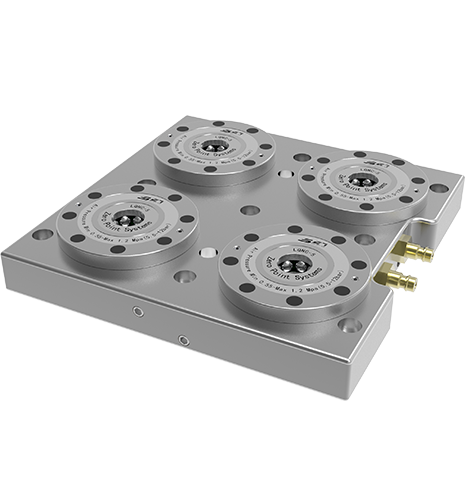 Four-Element Zero-Point Base Plate for Pallet SystemsThis base plate mounts four pallets or fixtures on a five-axis table, enabling off-machine setup. With 0.005mm repeated positioning accuracy and spring-locked, air-unlocked operation, it keeps the spindle cutting while you change workpieces.View Product →
This is the same principle shown in the five-axis zero-position quick-change applications used in aerospace and mold shops: the goal is to keep the machine cutting, not loaded and unloaded.
Choosing Between 3+2 and Simultaneous 5-Axis
The decision is not always about buying the most capable machine. You can apply the comparison to a single contract or a machine selection decision.
For simple prismatic parts, 3+2 is often faster. The program is simpler, collision risk is lower, and the tool does not need continuous interpolation. For moderate complexity, a 3+2 machine with a good workholding system can cover a large percentage of typical shop work.
For complex surfaces, simultaneous 5-axis is unavoidable. When the product is a turbine blade, a close-impeller, or a deep mold core, the surface normal changes direction continuously. A fixed-angle table cannot keep the tool at the right angle, and the only workaround is a longer tool, which brings chatter and deflection.
The important trade-offs are machine cost, programming complexity, and the need for skilled CAM programmers. A simultaneous 5-axis machine costs significantly more than a 3+2 machine of similar size, and the toolpath creation is more demanding.
Your average workload matters more than the machine nameplate. If only one part in ten is genuinely complex, the added cost of a full simultaneous machine and the programming time it demands may not pay off. If the majority of your contract work is complex five-axis geometry, then the process change should be driven by the cost and quality savings of one-setup machining.
Practical Workholding Considerations for 5-Axis
Once you invest in a five-axis machine, the workholding system determines how much of that investment you actually capture. These are the factors that separate a workable setup from a costly one.
- Rigidity: The fixture must resist cutting forces without springing or vibrating. A weak clamping system creates chatter and shortens tool life.
- Repeatability: Look for zero-point systems with inherent repeatability in the ±0.005 mm range. This allows you to swap pallets without re-indicating the part.
- Open access: Low-profile locators keep the tool travel area clear. The goal is to let the tool reach as much of the part as possible without touching the fixture.
- Automation readiness: If you plan to run the machine unattended, use pallet quick-change systems that a robot or hoist can handle. An automatic air pallet-lifting zero point unit is a typical choice for this application.
- Sensor capability: Positioners with sensor feedback alert the controller before cutting if a pallet is not seated. This is the cheapest insurance you can buy on an expensive five-axis machine.
Frequently Asked Questions
Q1: What is the difference between 3+2 and simultaneous 5-axis machining?
In 3+2, the rotary axes index to a fixed angle and the cut is made with X, Y, and Z motion. In simultaneous 5-axis, all five axes move together during the cut, so the tool orientation changes continuously along the tool path.
Q2: How much setup time can a zero-point system save?
Shops commonly report 60 to 90 percent reduction in setup time. A part that took 30 minutes to indicate and clamp can be swapped in under two minutes, because the datum is built into the zero-point locator rather than re-established manually.
Q3: Is simultaneous 5-axis always better than 3+2?
No. For simple flat-faced parts, 3+2 is faster to program, has fewer collision risks, and uses cheaper tooling. Simultaneous 5-axis is most valuable when the part has continuous curved surfaces or deep cavities that require constant tool orientation.
Q4: Can zero-point workholding improve workpiece stability on a five-axis machine?
Yes. A rigid, repeatable connection between the machine table and the workpiece reduces vibration and holds the part against cutting forces. You can read more about zero-point systems improve workpiece stability in 5-axis CNC machining in our technical article.
latest news
Latest news
-
How to Choose a 4th Axis Vise: Clamping Force, Size, and Zero-Point MountYou have a 4th axis rotary table, a batch of parts, and a need to cut three or four faces without re-fixturing each time. The most practical answer is a 4th axis vise mounted on a zero-point base pla...Read More
-
Pallet Changer Guide: Types, Benefits, and How to Choose the Right SystemA machining center idles for 15 to 20 minutes during every fixture changeover. The operator unscrews clamps, lifts the old fixture off the table, wipes down the T-slots, then indicates the next one i...Read More
-
Heavy Part 5-Axis CNC Machining: Key Workholding and Zero-Point SolutionsWhen a 500 kg cast housing reaches a 5-axis machining center, the real test begins before the spindle starts. The B-axis tilts the part, gravity shifts the load, and the cutting tool changes directio...Read More
-
Horizontal Machining Centers: Cut Setup Time with Zero-Point WorkholdingThe Real Bottleneck on Horizontal Machining Centers A horizontal machining center (HMC) can run continuously through faces of a part, but the hours lost between jobs are what often hurt the productio...Read More
-
Large Scale CNC Machining: How Workholding and Zero-Point Systems Maximize OutputPicture a 1.4 m cast-iron housing sitting beside a horizontal machining center. The spindle can remove metal quickly, but the real bottleneck is everything before the first chip: lifting the blank, l...Read More
Contact Details
- Address: 1-4 Floors, 17#03, Building 17, No. 269, Xinfeng Road, Xukou Town, Wuzhong District, Suzhou City
- Fax: +86-18112607008
- Tel: 18112607008
- Email: [email protected]
Mobile terminal
Copyright © SET Industrial | Zero-Point Positioning & CNC Workholding ALL RIGHTS RESERVED.