

 English
 русский
 Español
 简体中文

You have a 4th axis rotary table, a batch of parts, and a need to cut three or four faces without re-fixturing each time. The most practical answer is a 4th axis vise mounted on a zero-point base pla...
Read More
How to Choose a 4th Axis Vise: Clamping Force, Size, and Zero-Point Mount
You have a 4th axis rotary table, a batch of parts, and a need to cut three or four faces without re-fixturing each time. The most practical answer is a 4th axis vise mounted on a zero-point base plate. A matched vise and base plate deliver repeatable location and open access to the workpiece, but the choice involves clamping force, jaw width, rotation clearance, and mounting compatibility. Get these right and you reduce setup time and scrap; get them wrong and you will struggle with collisions or inconsistent reference points.
Why a 4th Axis Vise Beats a Simple Plate
On a rotary table, a flat plate lets you clamp a blank with straps or stops. The problem is that straps occupy the space where the tool should travel. A vise moves the clamp to the side of the part, giving the cutter access to three faces in one setup. This is why many machinists treat a vise as the default 4th axis workholding device.
Consider a small aluminum bracket. A 52mm double-position vise can hold two blanks side by side, letting you index the rotary table and machine both parts in one cycle. For a larger steel housing, a 96mm double-position vise provides the jaw width and clamping surface needed for heavier cuts. The vise also gives a clear stop for loading, which makes manual loading faster and more reliable.
When you rotate a vise on a 4th axis, the geometry changes. The jaw height and the distance from the rotation center determine whether the vise hits the spindle or the table. This is why we always check the swing radius before choosing a model. Our vice zero-change case shows how a vise and zero-point system work together on a machining center to keep the swing radius predictable.
There is another practical benefit: working with a vise reduces the need for custom fixtures. Instead of designing a dedicated clamping plate for every part, you can replace the jaws or use a quick step arrangement on the same vise body. For a busy job shop, that simplicity is often worth more than the cost of a specialized fixture.
What to Look for in a 4th Axis Vise
The key selection factors are repeated in almost every purchase decision. We recommend evaluating them in this order:
- Clamping force: The vise must resist the tangential force from the cutter, not just hold the part in place for light milling. For soft materials, high pressure can distort the part. For steel, more force helps resist chatter and improves surface finish.
- Jaw width: The jaws should cover the part without leaving overhang, and still allow the cutter to reach the lower faces.
- Rotation clearance: Calculate the maximum part and jaw height that will fit within the work envelope of your rotary table. A vise that looks good in the tool catalog can be too tall for your machine.
- Repeatable location: Look for a built-in stop or centering feature that lets you push the part against a known surface.
- Zero-point compatibility: A base plate adapter or direct interface is the fastest way to swap the vise on and off the machine.
The table below compares two common double-position vise families for typical 4th axis work.
| Factor | 52mm double-position vise | 96mm double-position vise |
|---|---|---|
| Best workpiece size | Small to medium parts | Medium to large parts |
| Number of stations | 2 | 2 |
| Typical mounting | Compact zero-point base plate | Large zero-point base plate |
| Common use | Aluminum, brass, small steel parts | Steel housings, castings, heavier cuts |
Notice that both families offer the same number of stations. The real difference is jaw capacity and available swing radius. If the part fits in a 52mm vise, the compact size keeps the rotating mass low and the work envelope open.
If automation is part of your plan, compare manual and pneumatic clamping. A manual vise is simple, affordable, and works well for low-volume work. A pneumatic vise opens the jaws automatically, which can shorten cycle time when a robot is loading parts. For a 5th axis or high-volume rotary setup, the extra cost of pneumatic clamping often pays back through consistently repeatable pressure.
Rule of thumb: If the part fits in a 52mm jaw, use the compact vise. If the part is wider than 52mm, move to a 96mm vise and verify the swing radius before you cut.
Zero-Point Integration: Making a Vise Truly Fast
A vise alone is only as repeatable as the table underneath it. Bolt it directly to the rotary table and each new setup requires dialing in the same location. A zero-point base plate solves this by providing a common reference across all jobs.
In a four-axis zero-position quick change setup, the base plate stays on the rotary table. The vise is fitted with a matching coupling or pull stud, so it can be dropped onto the plate and locked with a puller. The same principle works for tombstones, pallets, and other fixtures.
Foundation boards come in sizes such as 250-300-400mm, 630-800mm, and 800-1000mm. The choice depends on your rotary table. A larger board provides more mounting points, but a smaller board keeps the rotating mass low. For most single- or double-station vise work on a 4th axis, a 250-300-400mm zero-point locator foundation board is a practical starting point.
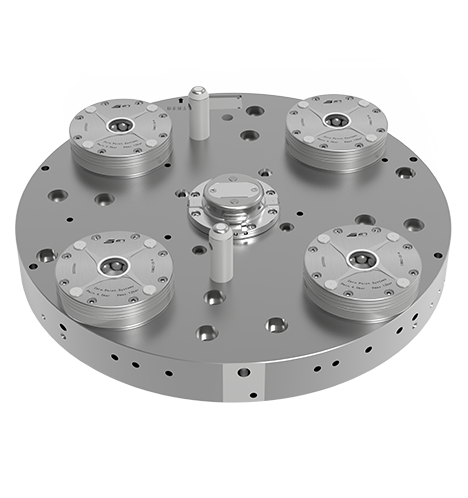 550mm Stainless Steel Zero-Point Foundation Board for 4th AxisThis 550mm stainless steel foundation board delivers 0.01mm repeat positioning and 78kN clamping force, with in-place detection. Its large mounting surface suits rotary tables while keeping setup fast and repeatable for vise changes.View Product →
The practical benefit is not only faster changeover. It is also repeatability. With a zero-point interface, each vise goes back to the same position, so you can trust your offsets and reduce scrap. When a pressing job arrives, you can remove the vises from the rotary table in minutes and switch to a pallet fixture without re-indicating.
Our Go-To Setups for 4th Axis Vise Work
Compact setup for small parts
If you are machining small components such as connectors, brackets, or sensor bodies, a 52mm double-position vise is a good fit. It clamps two parts at once and its compact width keeps the swing radius small. With a zero-point base plate underneath, you can load the vise on the rotary table, run your cycle, and move it to the presetter when the next job arrives.
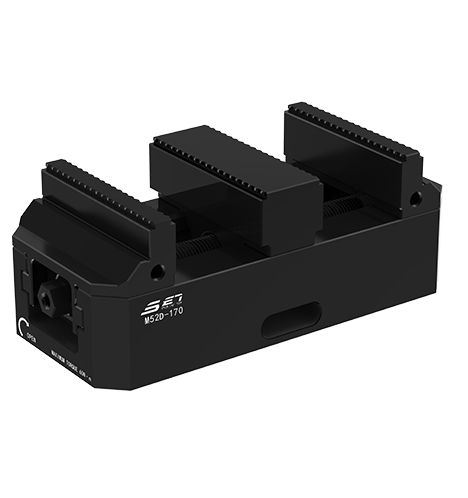 52mm Double Position Vise for Small Parts MachiningThis 52mm double-position vise clamps two small parts simultaneously, offering 13.5kN force and ±0.01mm repeatability. Its compact width keeps swing radius low, ideal for quick switching with a zero-point base plate.View Product →
Large setup for castings and housings
For larger steel parts, choose a 96mm double-position vise. The wider jaws support longer workpieces and the extra mass helps absorb chatter during heavier milling. This vise should sit on a larger foundation board. If your rotary table is sized for 96mm work, the added footprint is usually acceptable.
 96mm Double Position Vise for Larger WorkpiecesThis 96mm double-position vise provides a 116mm clamping range and 15kN force for larger parts. Wider jaws and hardened alloy steel construction absorb chatter, best used with a bigger foundation board for heavy milling.View Product →
In both setups, the two key decisions are jaw width and zero-point mounting. Once you settle those, the rest of the fixture design becomes a routine detail. A common practice is to keep a spare vise ready on a second foundation board, so you can pre-set the jaws off the machine while the current job is still running.
FAQ
Q1: Can I use any vise on a 4th axis?
Any vise can physically be mounted, but not every vise is safe or efficient. You need to check the jaw height, swing radius, and clamping force against your rotary table and part program. A vise with too much overhang can cause a collision when the table rotates.
Q2: How does a zero-point base plate help with a 4th axis vise?
The base plate standardizes the position of the vise. Instead of indicating the vise every time you change jobs, you drop it onto the plate and lock it. This improves repeatability and reduces setup time, especially when multiple fixtures share the same machine.
Q3: What is the difference between manual and pneumatic 4th axis vises?
Manual vises are faster to set up because they rely on a built-in mechanism, but they require the operator to apply clamping force by hand. Pneumatic vises use compressed air to actuate the jaws, which supports automated or semi-automated loading. For a 4th axis that already rotates and indexes, pneumatic clamping can shorten the total cycle.
Q4: Do I need a tombstone-style fixture for a 4th axis vise?
Not always. A tombstone helps when you need many workpieces in one cycle or when the part geometry requires a vertical orientation. For many three-face machining jobs, a single vise or a pair of vises on a zero-point base plate is simpler and more flexible.
Q5: How do I verify that my 4th axis vise is centered correctly?
Use a test indicator on the reference surface of the vise body, rotate the table, and check for runout. If you are using a zero-point base plate, run the same check on every new vise you install. A deviation of a few hundredths of a millimeter will affect the part position, but if you correct it once and keep the same plate, the next setup stays consistent.
Choose the 4th axis vise by matching the work envelope, clamping force, and zero-point interface. For small parts, a compact double-position vise is the best starting point. For heavier work, move up to a larger jaw. Add a foundation board to make the vise repeatable and fast to change. In short, the best 4th axis vise is the one that fits your actual part size and keeps your offsets stable from job to job.
latest news
Latest news
-
Pallet Changer Guide: Types, Benefits, and How to Choose the Right SystemA machining center idles for 15 to 20 minutes during every fixture changeover. The operator unscrews clamps, lifts the old fixture off the table, wipes down the T-slots, then indicates the next one i...Read More
-
Heavy Part 5-Axis CNC Machining: Key Workholding and Zero-Point SolutionsWhen a 500 kg cast housing reaches a 5-axis machining center, the real test begins before the spindle starts. The B-axis tilts the part, gravity shifts the load, and the cutting tool changes directio...Read More
-
Horizontal Machining Centers: Cut Setup Time with Zero-Point WorkholdingThe Real Bottleneck on Horizontal Machining Centers A horizontal machining center (HMC) can run continuously through faces of a part, but the hours lost between jobs are what often hurt the productio...Read More
-
Large Scale CNC Machining: How Workholding and Zero-Point Systems Maximize OutputPicture a 1.4 m cast-iron housing sitting beside a horizontal machining center. The spindle can remove metal quickly, but the real bottleneck is everything before the first chip: lifting the blank, l...Read More
-
Air Gripper Selection Guide: Types, Grip Force, and Automation IntegrationA robot cell that runs five different part numbers in one shift is no longer unusual. The air gripper at the end of the arm picks and places, but when the product changes, the gripper often has to be...Read More
Contact Details
- Address: 1-4 Floors, 17#03, Building 17, No. 269, Xinfeng Road, Xukou Town, Wuzhong District, Suzhou City
- Fax: +86-18112607008
- Tel: 18112607008
- Email: [email protected]
Mobile terminal
Copyright © SET Industrial | Zero-Point Positioning & CNC Workholding ALL RIGHTS RESERVED.